
By Anton, a manual driving instructor with 16+ years of teaching experience.
How does a clutch work?
If you have wondered why lifting your left foot makes the car move, follow the connection inside the bellhousing, where the engine and gearbox meet. This guide uses a typical single plate dry clutch in a modern manual passenger car. Motorcycles and racing cars can use different arrangements.
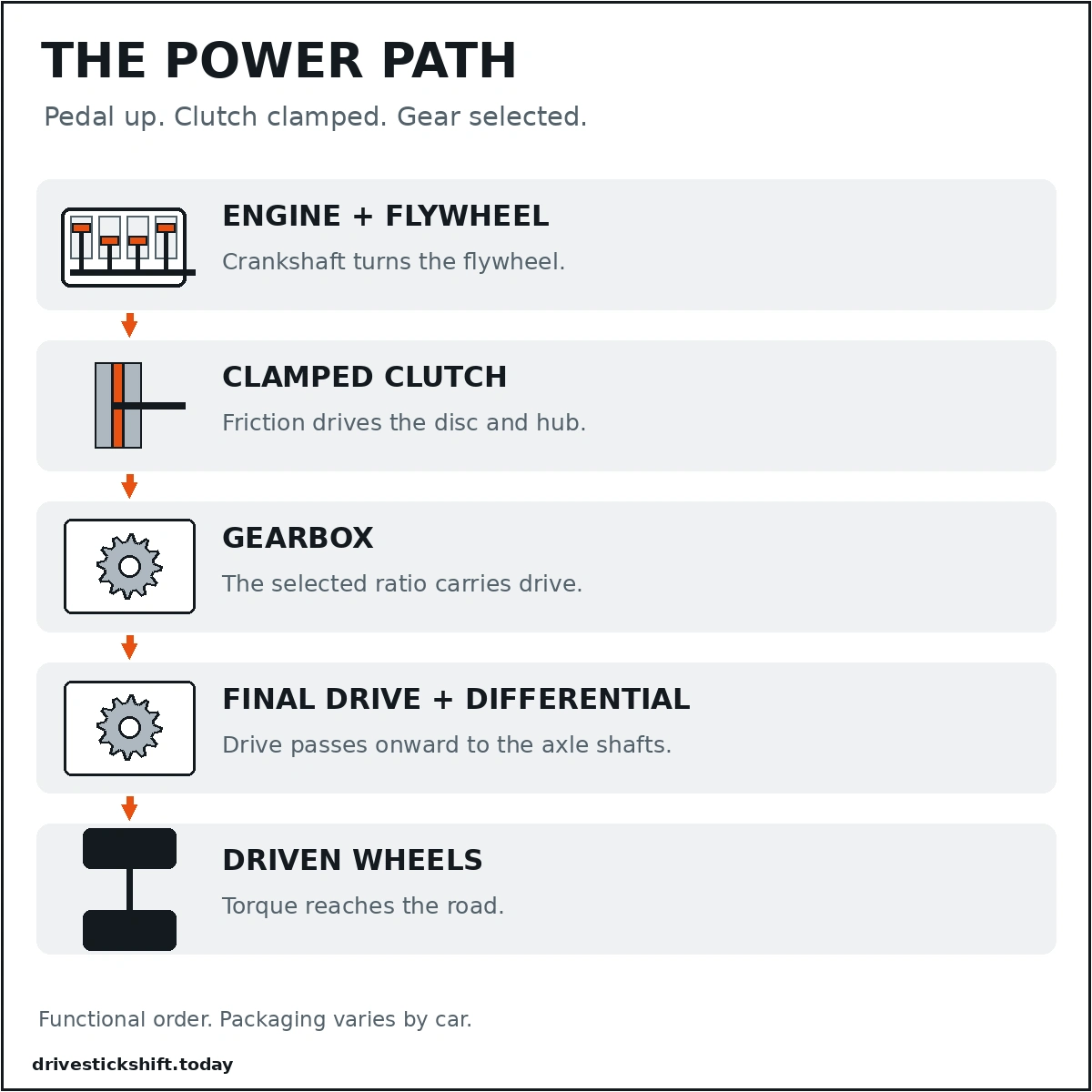
Follow the power path from the crankshaft to the wheels
During acceleration with a gear selected, engine torque travels from the crankshaft to the flywheel, across the clamped clutch disc and into the gearbox input shaft. The selected gear ratio passes it onward through the final drive and differential to the driven wheels.
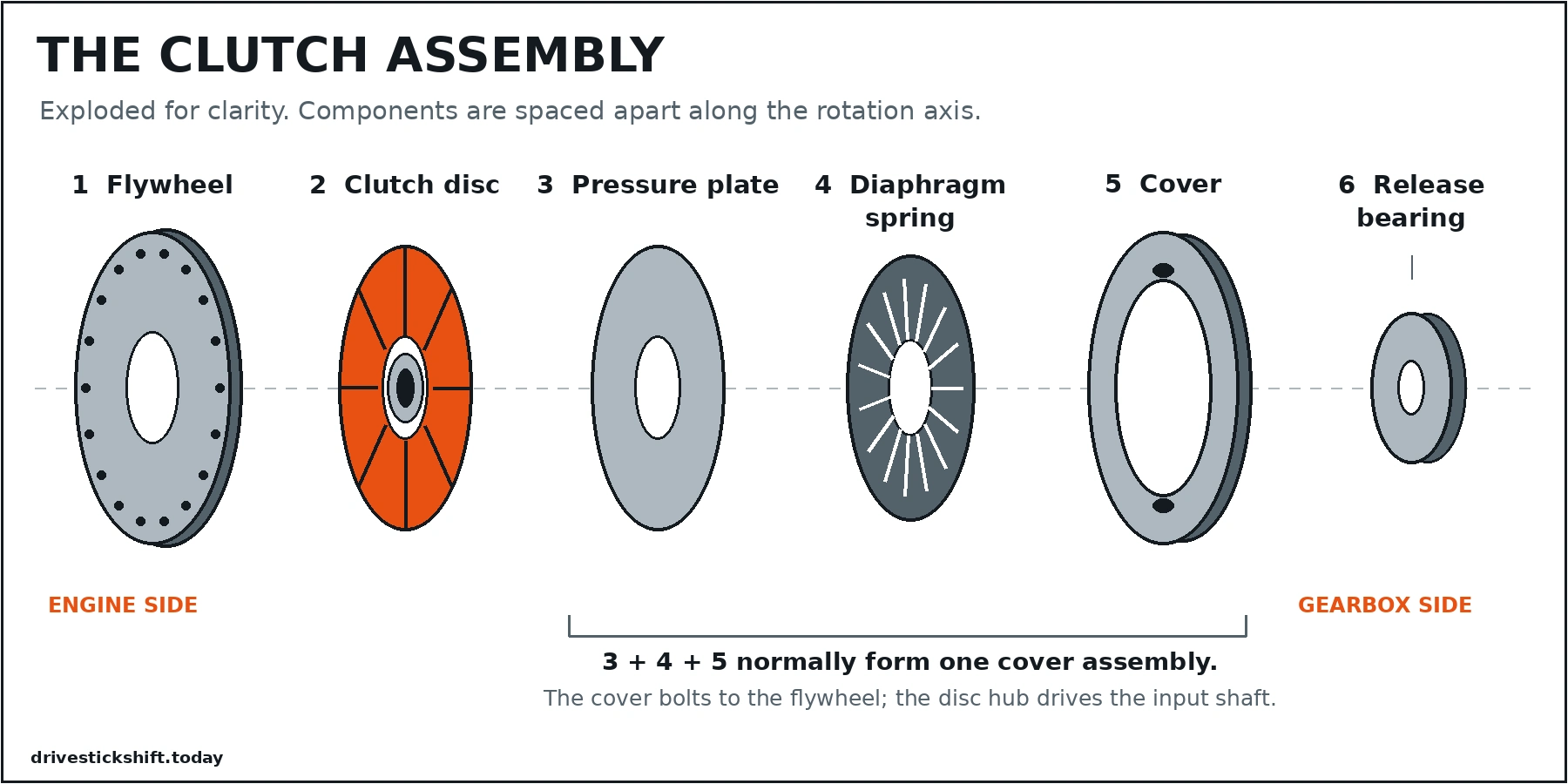
The pressure plate provides the squeeze that makes this possible. It is part of an assembly bolted to the flywheel, so the disc receives friction torque from both the flywheel and pressure plate faces. Its splined center hub drives the input shaft.
The diagram shows functional order, not a particular car’s packaging. In many cars with front wheel drive, the gearbox, final drive and differential share one transaxle housing. A car with rear wheel drive commonly has a separate driveshaft leading to the differential.
Move the clutch pedal yourself in the Clutch Lab simulator.
The clutch parts, explained without the mystery
| Part | What it does |
|---|---|
| Flywheel | Connects to the crankshaft and provides one friction surface. Its rotating mass helps smooth changes in engine speed. |
| Clutch disc | Has friction material on both sides. Its splined hub connects it to the gearbox input shaft. |
| Pressure plate | Provides the other friction surface and squeezes the disc against the flywheel. |
| Diaphragm spring | Applies the clamping force. Its inner fingers let the release mechanism change that force. |
| Clutch cover | Bolts to the flywheel and supports the spring and pressure plate mechanism. |
| Release bearing | Also called the throwout bearing. Transfers release force to the rotating spring fingers. |
The pedal does not supply the normal clamping force. The diaphragm spring does. Your foot operates the mechanism that reduces that clamp load. That explains the part beginners often find backward.
Pedal up means engaged. Pedal down means released.
Foot off the pedal: the disc is clamped
With a healthy clutch fully engaged, the flywheel, disc and pressure plate turn together without sustained slip. Engine RPM therefore matches gearbox input shaft RPM, not wheel RPM. Gear ratios and the final drive account for the difference at the wheels.
Being in neutral is a separate condition. The clutch can be engaged and turning the gearbox input shaft while neutral leaves no selected driving connection to the wheels.
Pedal fully down: the clamp is released
In the common push type design shown below, the release bearing presses the inner diaphragm spring fingers toward the engine. The spring pivots around its supports, allowing the pressure plate to lift away from the disc. The small clearances are exaggerated in the diagram.
The engine can now turn independently of the input shaft. It has not switched off, and the gearbox has not necessarily stopped rotating. In a moving car with a gear selected, the wheels can still turn the gearbox input shaft through that gear.
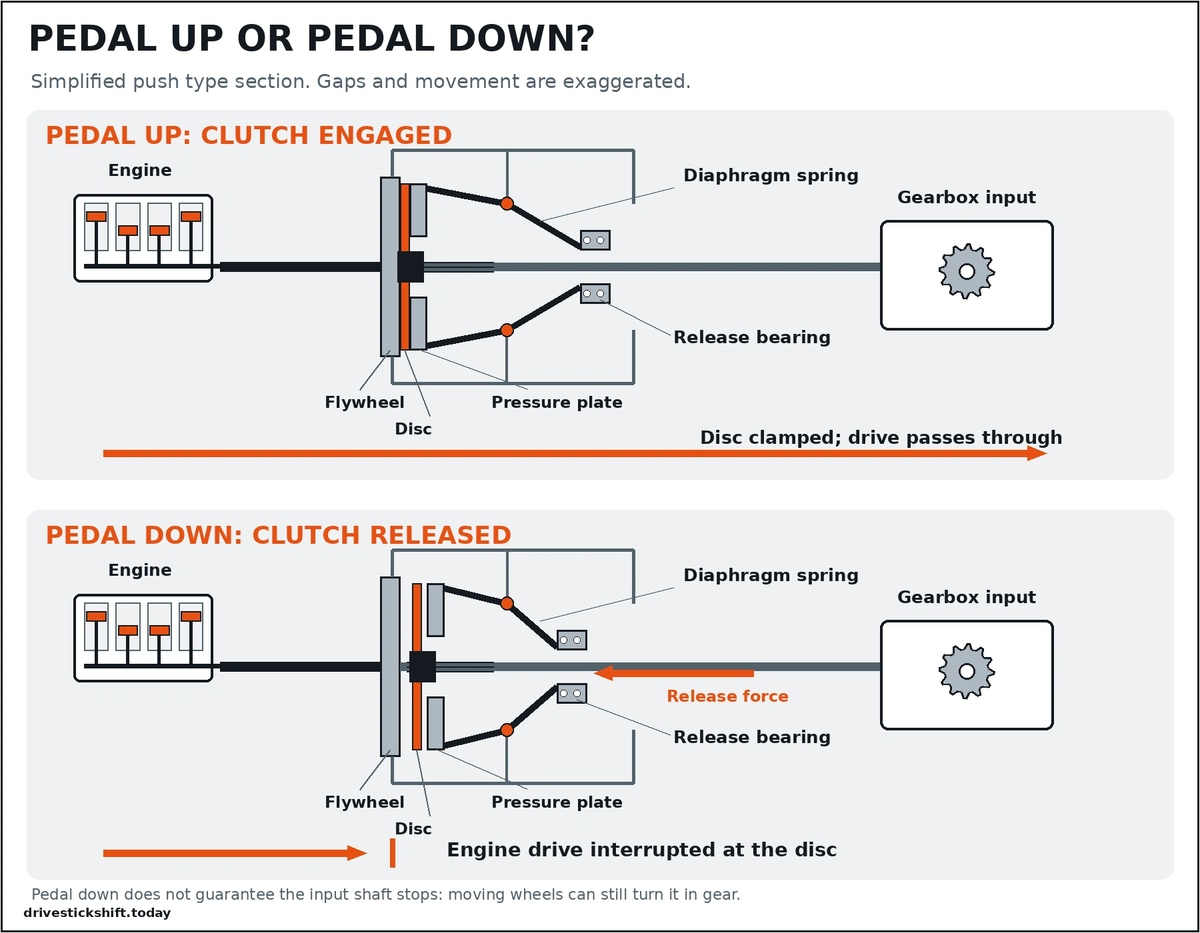
Picture two hands: one represents the engine side and the other the wheel side. Bring your fingers together to show a connection, then separate them to show disconnection. That is the basic job of the clutch: it controls the connection between the engine and the driveline.
What does the clutch pedal actually move?
In a hydraulic system, your foot moves a piston in the clutch master cylinder. Pressure travels through fluid in a line to the slave cylinder. The slave then operates the release mechanism.
- Your foot moves the pedal and master cylinder piston.
- Hydraulic pressure reaches the slave cylinder.
- In the external slave arrangement shown, the slave moves a release fork.
- The fork moves the release bearing against the spring fingers.
- Clamp load falls and the pressure plate releases the disc.
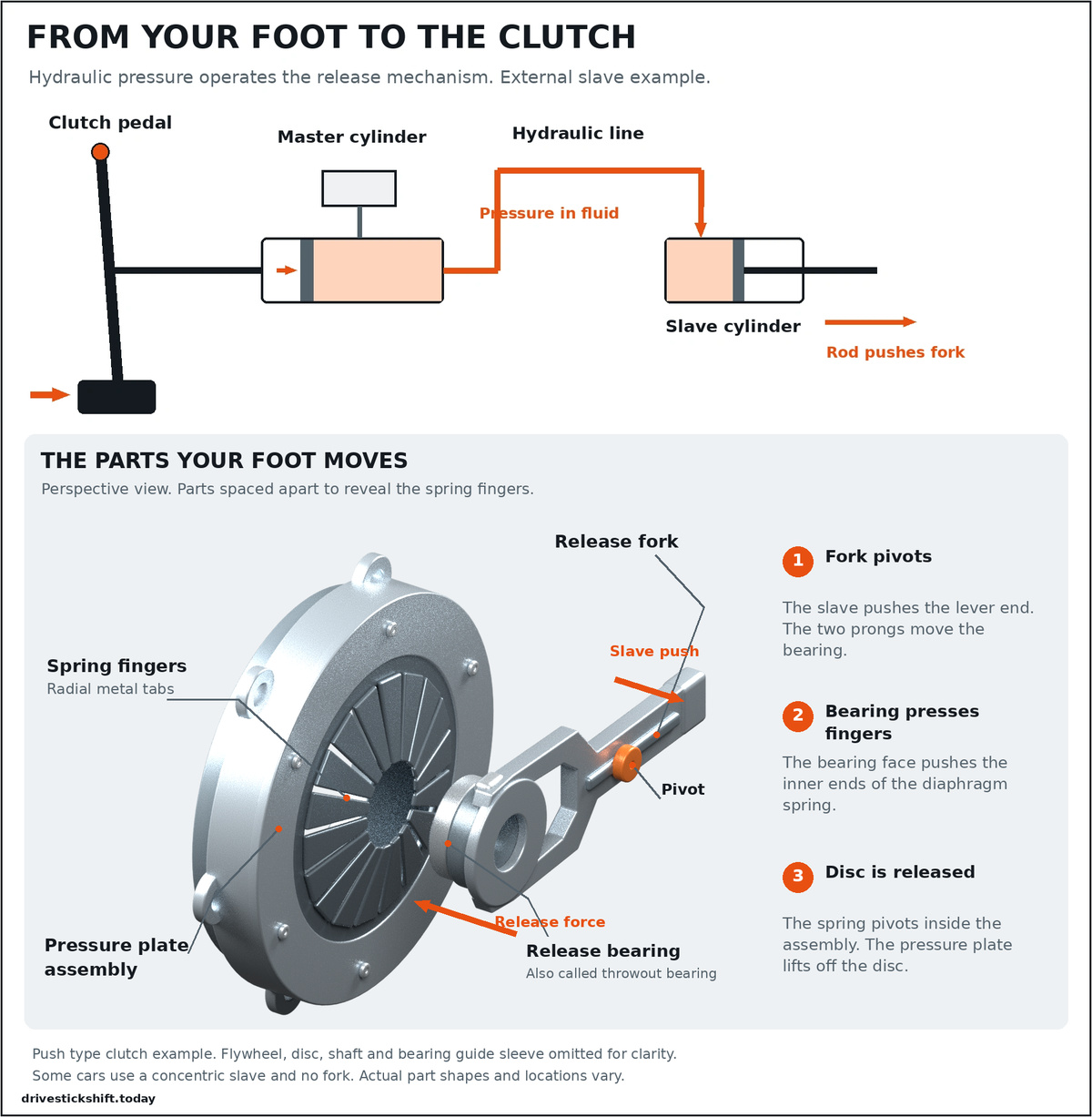
Other cars use that concentric slave cylinder instead of a separate fork. Some use a mechanical cable to pull the release mechanism. The connection changes; the job remains releasing the spring’s grip. The hydraulic fluid operates the mechanism, not the dry friction surfaces.
Your pedal resistance comes through this release system. It does not directly tell you how much torque the clutch is transmitting. Some modern release bearings stay in light contact while the pedal is up, so “bearing turning” and “clutch slipping” are not the same thing.
What the bite point physically is
As you lift the pedal, the release mechanism backs off and the pressure plate begins building clamp load on the disc. The bite point is the beginning of the useful engagement range where enough friction torque is transmitted for you to notice the engine taking load or the car beginning to move.
It is not a latch, a tooth clicking into place or a universal halfway mark on the pedal. Disc cushioning, spring behavior and the release mechanism make engagement progressive, and the pedal position varies by car.
During a launch, the engine is already turning while the car and gearbox side start much slower. Brief, controlled slip lets those speeds come together while the car gains speed. Releasing too abruptly can load the engine faster than it can cope, causing a jerk or stall.
Once you are moving and the speeds have come together, finish releasing the pedal. The goal is to pass through the engagement range with control, rather than stay there. For shifting technique, read Why Your Car Jerks When Shifting Gears: Causes and Fixes.
Why slipping the clutch makes heat and wear
While the friction surfaces transmit torque at different speeds, some mechanical energy becomes heat. Under the same transmitted torque, a bigger speed difference produces heat faster. Holding that condition longer adds more heat.
Brief slip during a controlled launch is normal. Prolonged slip with lots of throttle, or balancing the car on the clutch on a hill, creates unnecessary heat and wear. Use the brakes to hold the car. Once engaged, keep your resting foot off the clutch pedal.
For the damage side, read How Do You Burn a Clutch? Causes, Signs and Prevention.
What about a dual mass flywheel?
A dual mass flywheel divides the flywheel into an engine side mass and a clutch side mass, connected through a spring and damping system. They can move through a limited angle relative to each other, helping isolate engine torque pulses before those pulses reach the gearbox.
It is a vibration control device, not a second clutch or an automatic transmission. Your clutch disc still needs the same controlled engagement. Not every manual car has one.
Frequently asked questions
Is the clutch engaged when I press the pedal?
Normally, no. Pressing the pedal releases the clutch; lifting it allows the spring to clamp the disc. “Engaged” describes the mechanical connection, not whether your foot is pressing something.
Does pressing the clutch put the gearbox in neutral?
No. It separates the engine from the gearbox while the selected gear can remain selected. Neutral is a separate position in the gearbox.
Why can the engine keep running with the car stopped?
With the clutch fully released by the pedal, the engine can rotate without having to turn the stationary driveline. In neutral, the gearbox also lacks a selected driving connection to the wheels, even if the clutch pedal is up.
Is the bite point always halfway up?
No. The position and feel vary by vehicle and system condition. Learn the change in engine load and engagement instead of relying on a fixed pedal height.
Does a heavy pedal mean a stronger clutch?
Not reliably. Pedal effort also depends on spring design, leverage, hydraulics and friction in the release mechanism. Effort alone cannot tell you the clutch’s torque capacity or condition.
Want to connect the diagram to what you feel in a real car? Book a stick shift lesson in Brooklyn. We welcome drivers from NYC and the tri state area.
