
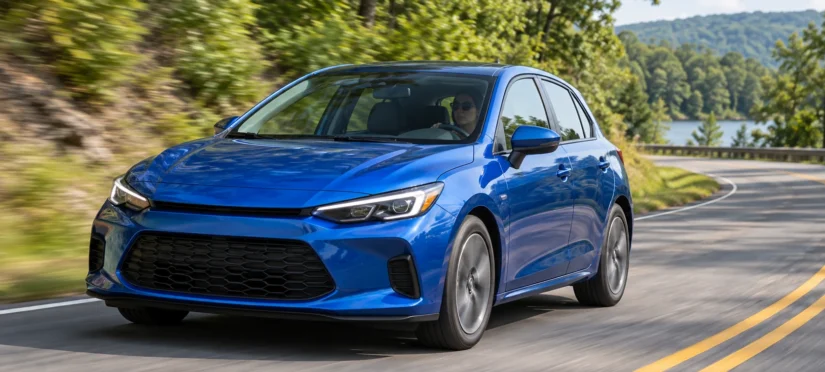
A continuously variable transmission changes its effective ratio through a range instead of relying only on a fixed sequence of forward ratios. To the driver, that can mean smooth acceleration without the familiar rise-and-fall rhythm of conventional shifts.
The letters CVT do not describe one universal gearbox. Understanding the actual design is more useful than assuming every car carrying the label behaves or lasts the same way.
How a Belt or Chain CVT Changes Ratio
In a common automotive arrangement, adjustable pulleys change the effective diameters on which a steel belt or chain runs. Varying those diameters changes the relationship between engine speed and road speed.
Under acceleration, the engine may hold near a chosen speed while the car continues gaining speed. That does not mean the vehicle is stuck at one speed or the transmission has failed to shift. It can be normal operation for that design and driving situation.
Explore the CVT Carousel: Use the arrows to browse six illustrated slides covering operation, advantages, tradeoffs, documented concerns and Toyota’s two different designs. Each slide also has a full-size viewing link.
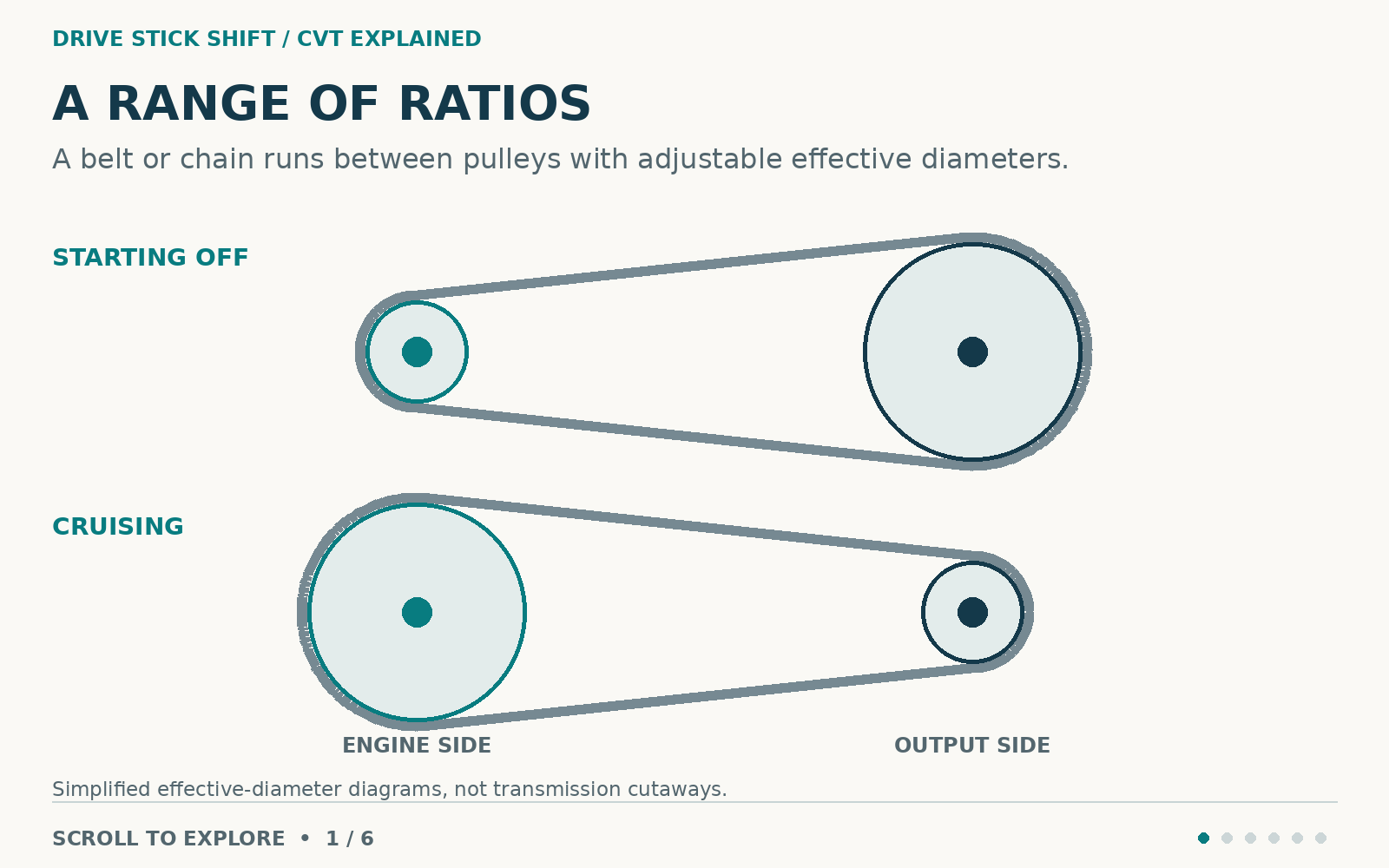
How Ratios Change · View full-size slide 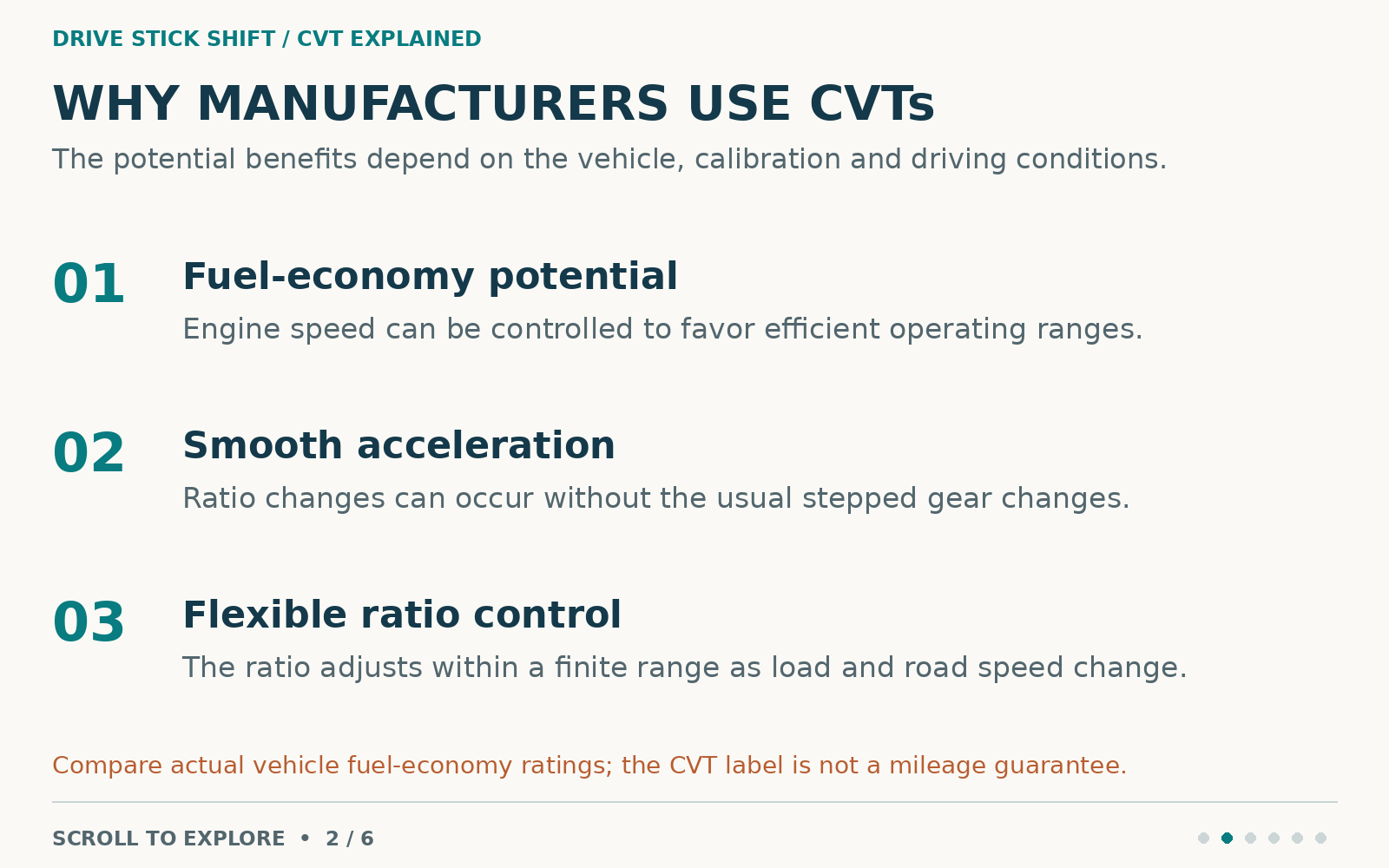
Potential Benefits · View full-size slide 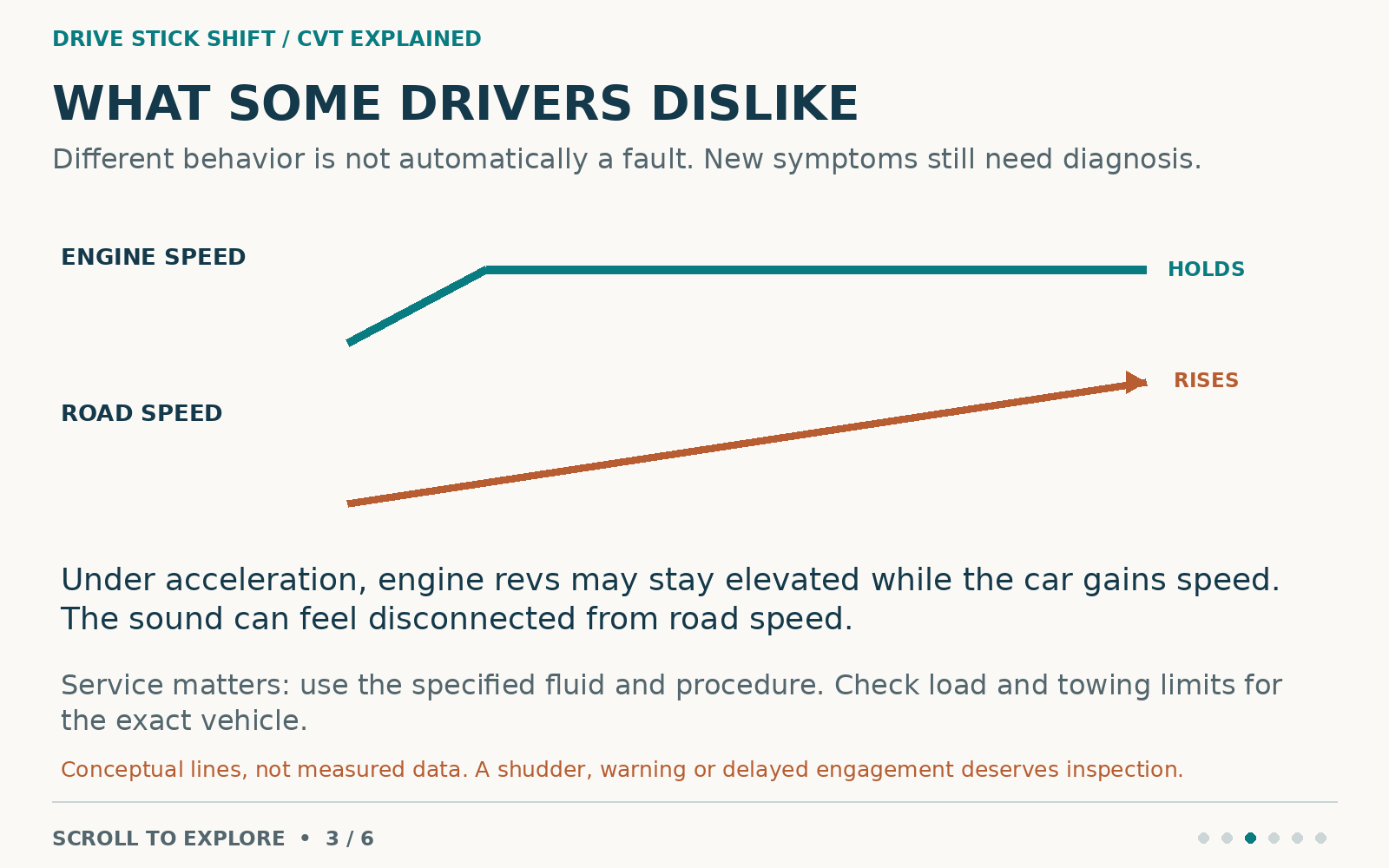
Feel And Service Tradeoffs · View full-size slide 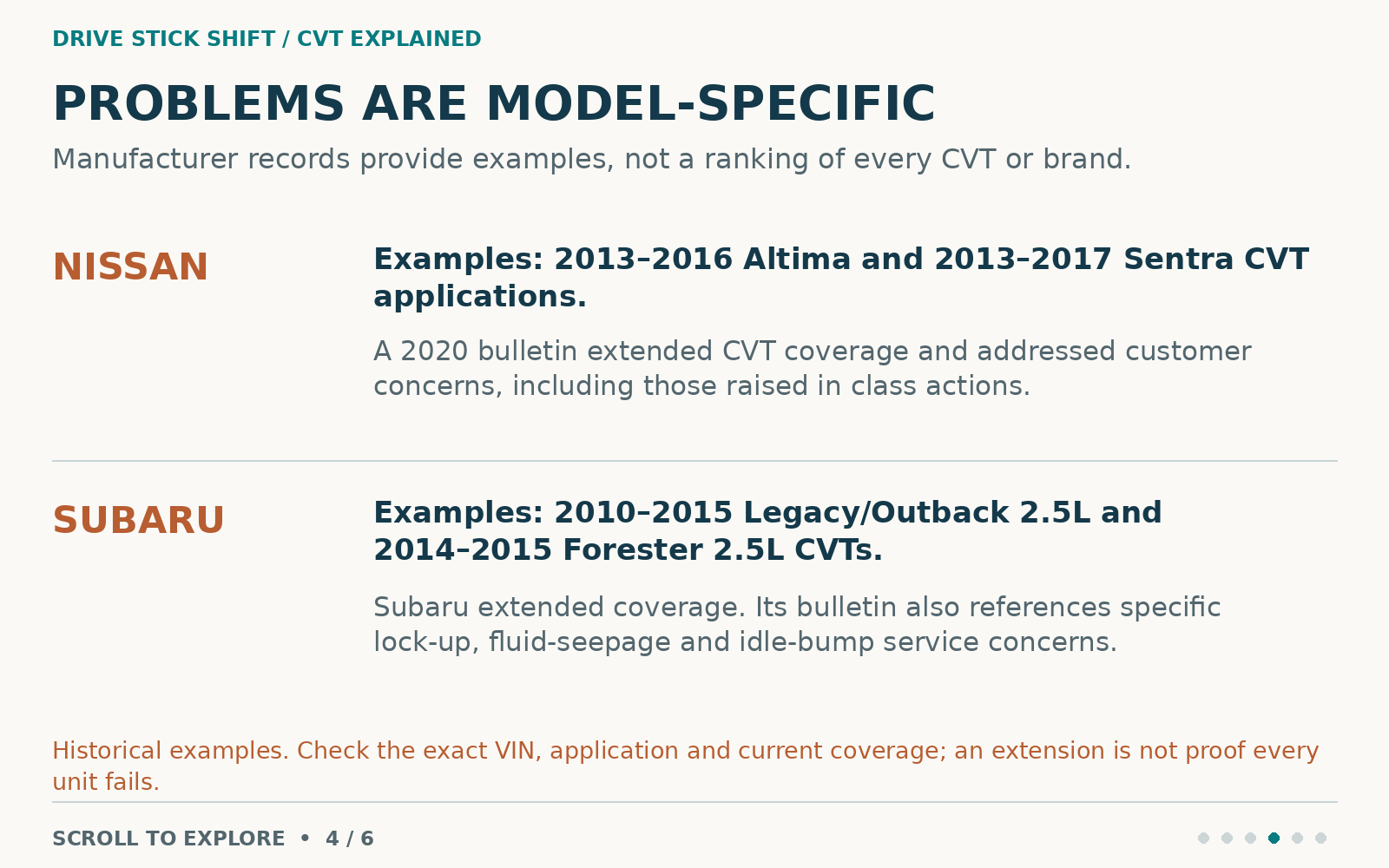
Documented Nissan Subaru Examples · View full-size slide 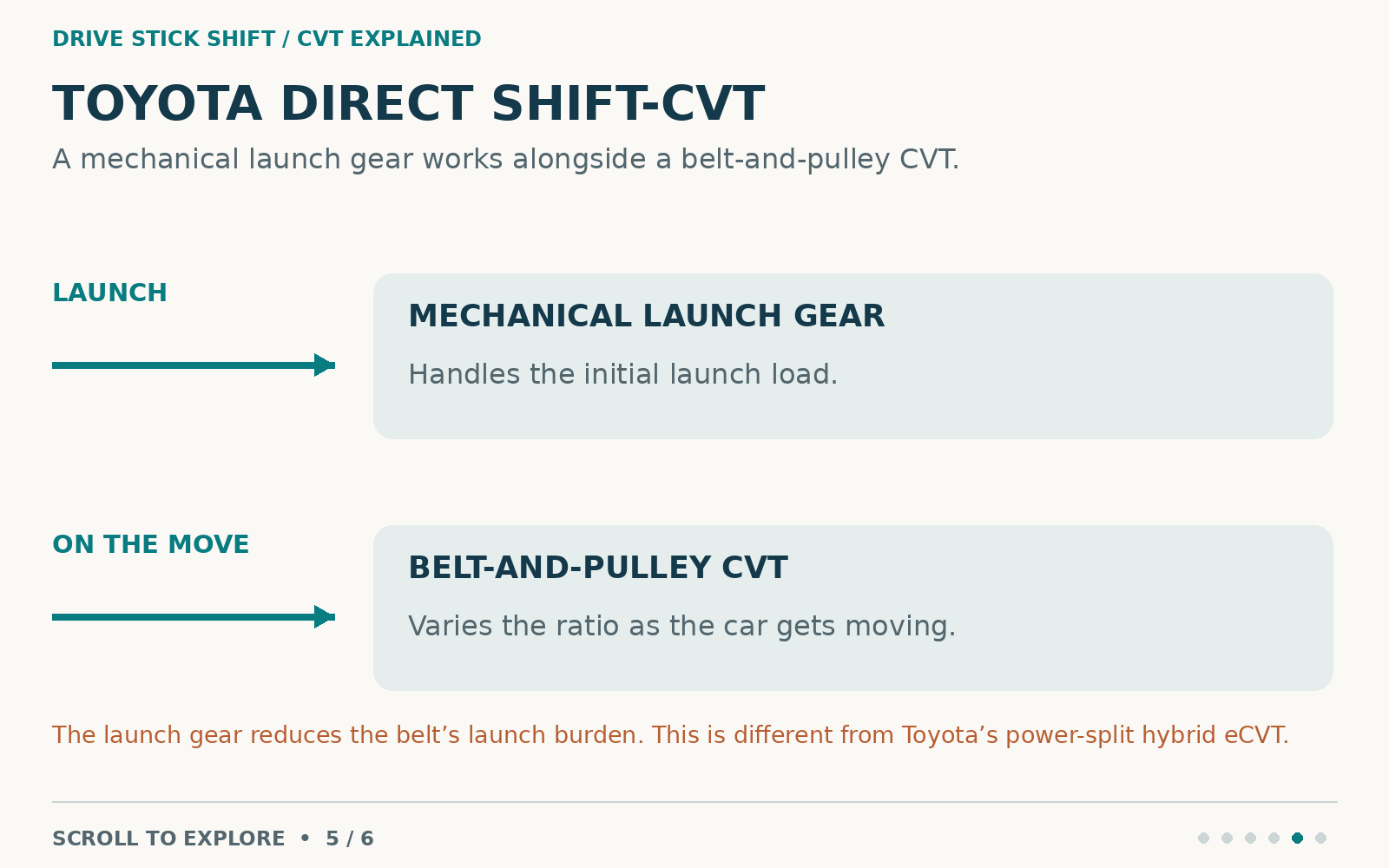
Toyota Direct Shift Launch Gear · View full-size slide 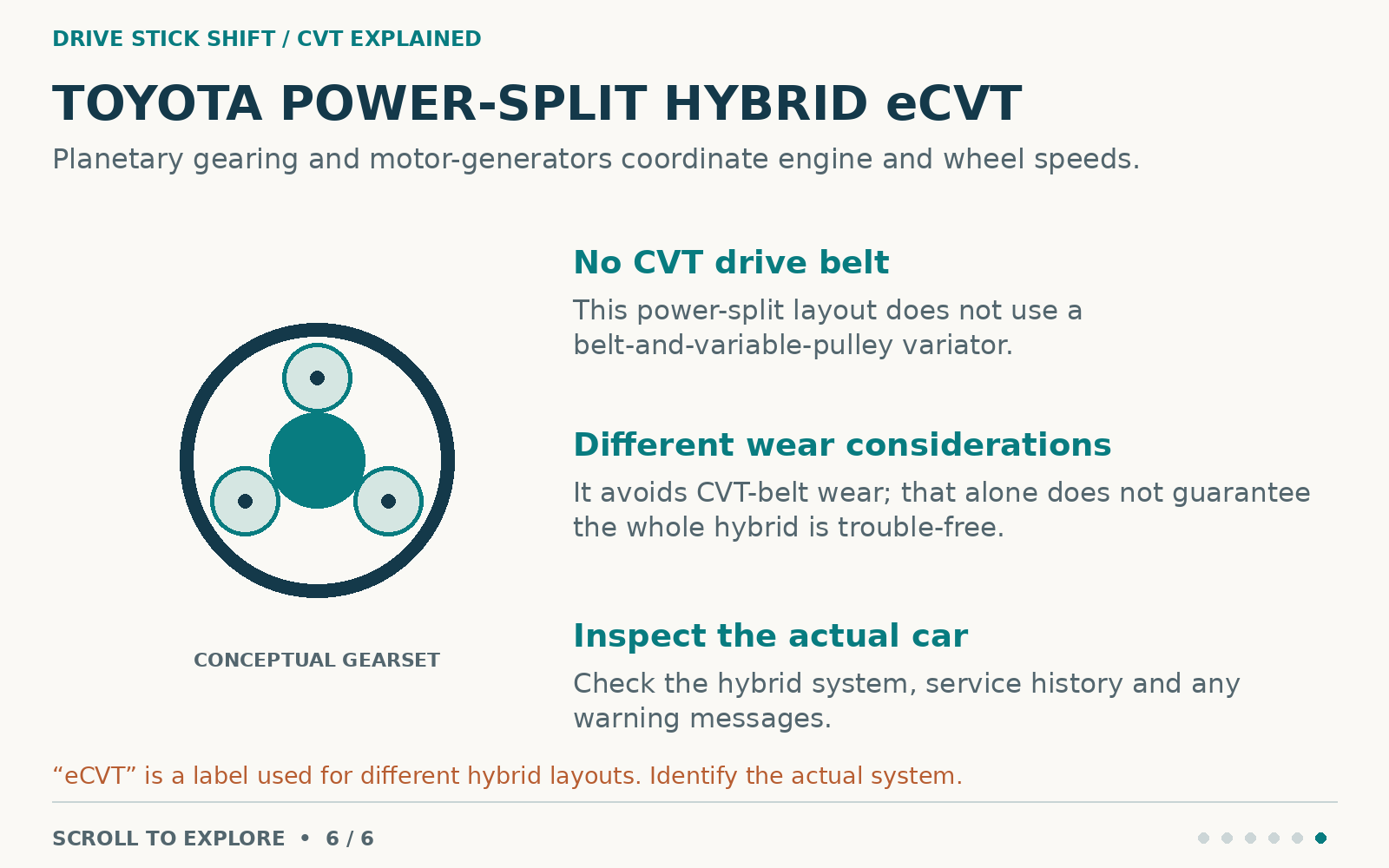
Toyota Hybrid Planetary Ecvt · View full-size slide
Carousel Sources
Toyota Direct Shift-CVT; Toyota power-split hybrid system; Nissan CVT bulletin; Subaru bulletin 16-107-17R. Drawings are simplified explanations, not service diagrams. Historical warranty programs do not establish current coverage or brand-wide failure rates.
Why Saying a CVT Has No Gears Is Misleading
A variable-ratio mechanism does not imply the whole transmission contains no gears. Final-drive and reversing arrangements vary. Toyota’s Direct Shift-CVT adds a physical launch gear alongside its belt-and-pulley system. The gear handles initial launch duty, reducing the load placed on the belt at launch; the belt system supplies variable-ratio operation as the car gets moving. This is a different design from Toyota’s planetary power-split hybrid eCVT.
Some CVTs also simulate stepped shifts. A paddle or a manual-mode selector can request programmed ratio points without turning the transmission into a conventional manual gearbox. The controls alone do not identify the internal mechanism.
A Hybrid eCVT Can Be a Different System
In a power-split hybrid design described by Toyota, a gearset and controlled motor-generators coordinate the engine and wheel speeds. It does not use the same belt-and-variable-pulley mechanism simply because its name includes eCVT.
That power-split layout has no CVT drive belt or variable-pulley variator, so belt-specific wear concerns do not transfer to it. It still needs assessment as a complete hybrid system, including its maintenance history and any warning messages. Check the actual design rather than treating either “Toyota” or “eCVT” as a guarantee against every failure.
Advantages and Tradeoffs You May Notice
The advantages: Smooth ratio changes can avoid the usual stepped-shift interruptions. Flexible engine-speed control can favor efficient operating ranges and support fuel economy, depending on the car and conditions. A CVT adjusts through a finite ratio range; that is different from adding more physical gears. Compare fuel-economy ratings for the actual vehicles rather than assuming the CVT must use less fuel.
The tradeoffs: Some drivers dislike the sustained engine sound or the way revs and road speed change differently under acceleration. Some CVTs simulate stepped shifts to create a more familiar feel. Heat management, fluid requirements and load limits depend on the application. A serious fault can also mean a substantial repair bill, so maintenance records and an independent inspection matter when buying used.
Drivers who enjoy choosing gears and coordinating a clutch may prefer a conventional manual. Drivers who value easy operation in traffic may prefer a different setup. Neither preference establishes which specific used car is mechanically healthier.
Manufacturers With Documented CVT Concerns
Nissan: A May 2020 CVT warranty bulletin covers particular applications, including 2013–2016 Altima and 2013–2017 Sentra CVT models. It describes extended coverage and customer concerns, including those raised in class actions. The bulletin’s full list and VIN-specific terms matter; it does not describe every Nissan or every CVT.
Subaru: Bulletin 16-107-17R extended coverage for selected CVT applications, including 2010–2015 Legacy/Outback 2.5L and 2014–2015 Forester 2.5L models. It also references application-specific lock-up, fluid-seepage and idle-bump service concerns. Subaru stated that the extension was not in response to a specific condition.
These are historical examples to guide research, not promises of current warranty coverage or proof that every example will fail. Identify the exact car, investigate its service history and have any symptoms diagnosed.
Used CVT Buying Checklist
- Identify the precise year, engine and transmission, not just the model name.
- Check maintenance records against the manufacturer’s procedure and exact fluid specification.
- Research applicable recalls and any remaining coverage for that specific vehicle; do not assume an old warranty announcement still applies.
- Arrange an independent inspection and assess operation under appropriate conditions.
- Ask a qualified technician about shudder, delayed engagement, leaks, warning messages or unusual noises rather than diagnosing them from an online description.
A fixed service interval or a universal fluid recommendation copied from another car can be wrong. Before authorizing maintenance, ask the workshop which specification and procedure it will use and why they match your vehicle.
Can You Learn Manual Driving in a CVT Car?
No conventional clutch-and-H-pattern skill is developed simply by using an automatic’s simulated shift mode. A conventional manual adds clutch engagement and a different coordination task.
If you want to understand that contrast, explore the free Clutch Lab. It demonstrates conventional clutch concepts, not CVT operation. Drive Stick Shift lessons provide practical manual-car instruction when you are ready to try the skill in a real vehicle.
Are All CVTs Unreliable?
No responsible comparison can be made from that label alone. Assess the particular design, maintenance history, condition and likely repair costs. The same discipline applies when shopping for a manual, a conventional automatic or a hybrid.
