
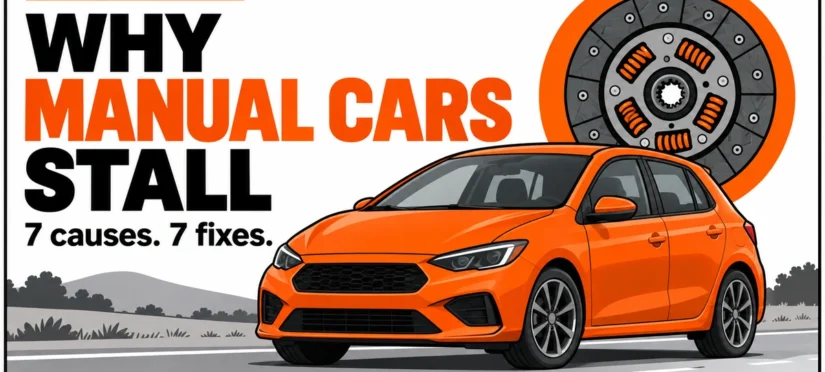
By Anton, a manual driving instructor with 16+ years of teaching experience.
Quick answer: Manual cars stall when the engine cannot produce enough torque to keep turning against the load on it. During a launch, releasing the clutch too quickly or using too little gas can pull engine speed below a sustainable level. Use first gear, release smoothly through the bite, and match the gas to the load.
If you are asking why do manual cars stall, start by identifying when your car stalls: during the launch (classic stall), while slowing to a stop, or after you have already stopped. Each points to a different correction. This guide covers typical modern, fuel injected cars with synchronized manual transmissions.
Why Do Manual Cars Stall? The Mechanics in Plain English
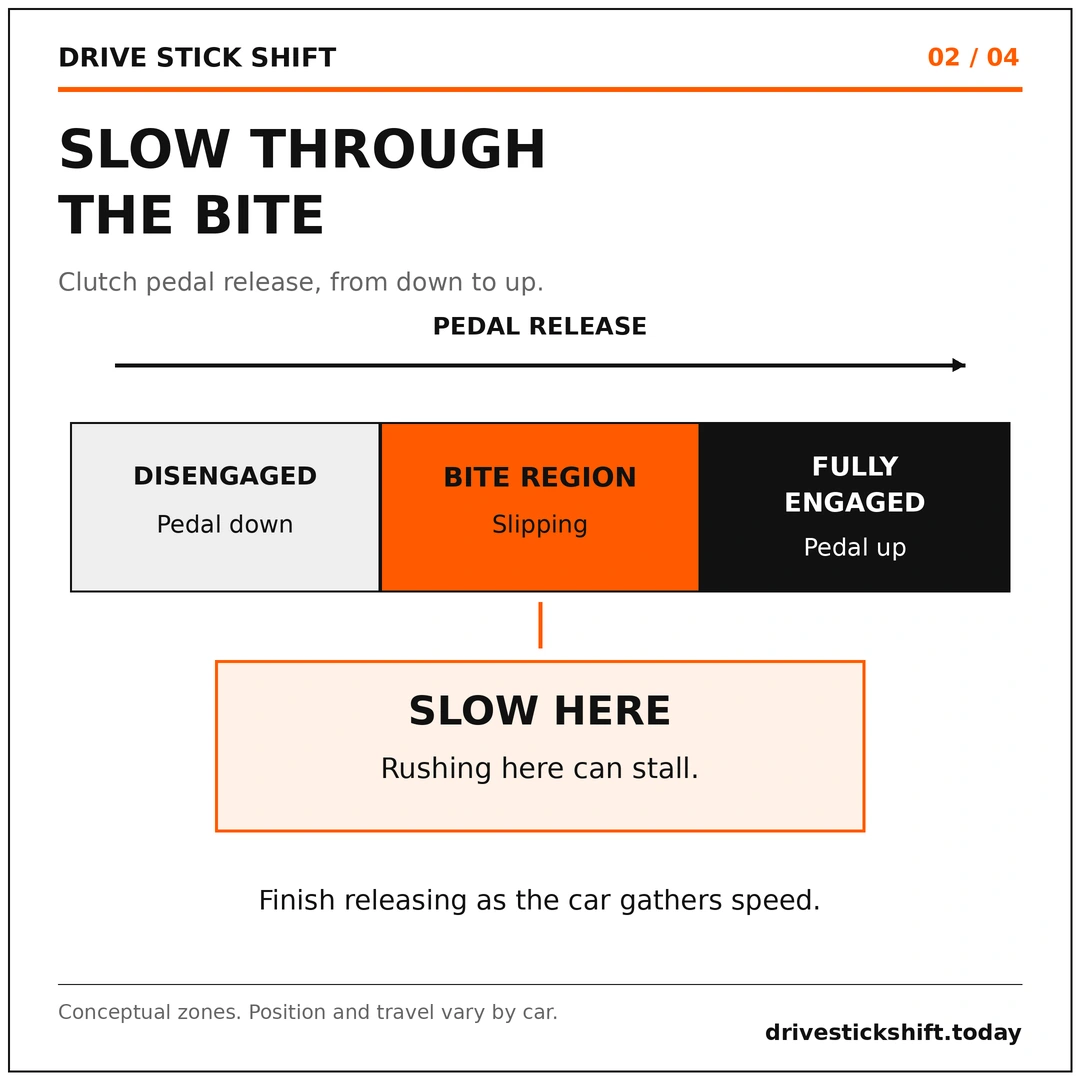
The engine can run while the car stands still because pressing the clutch pedal separates the engine from the transmission. As you lift the pedal into the bite region, the clutch begins transferring torque. Now the engine has to help accelerate the car.
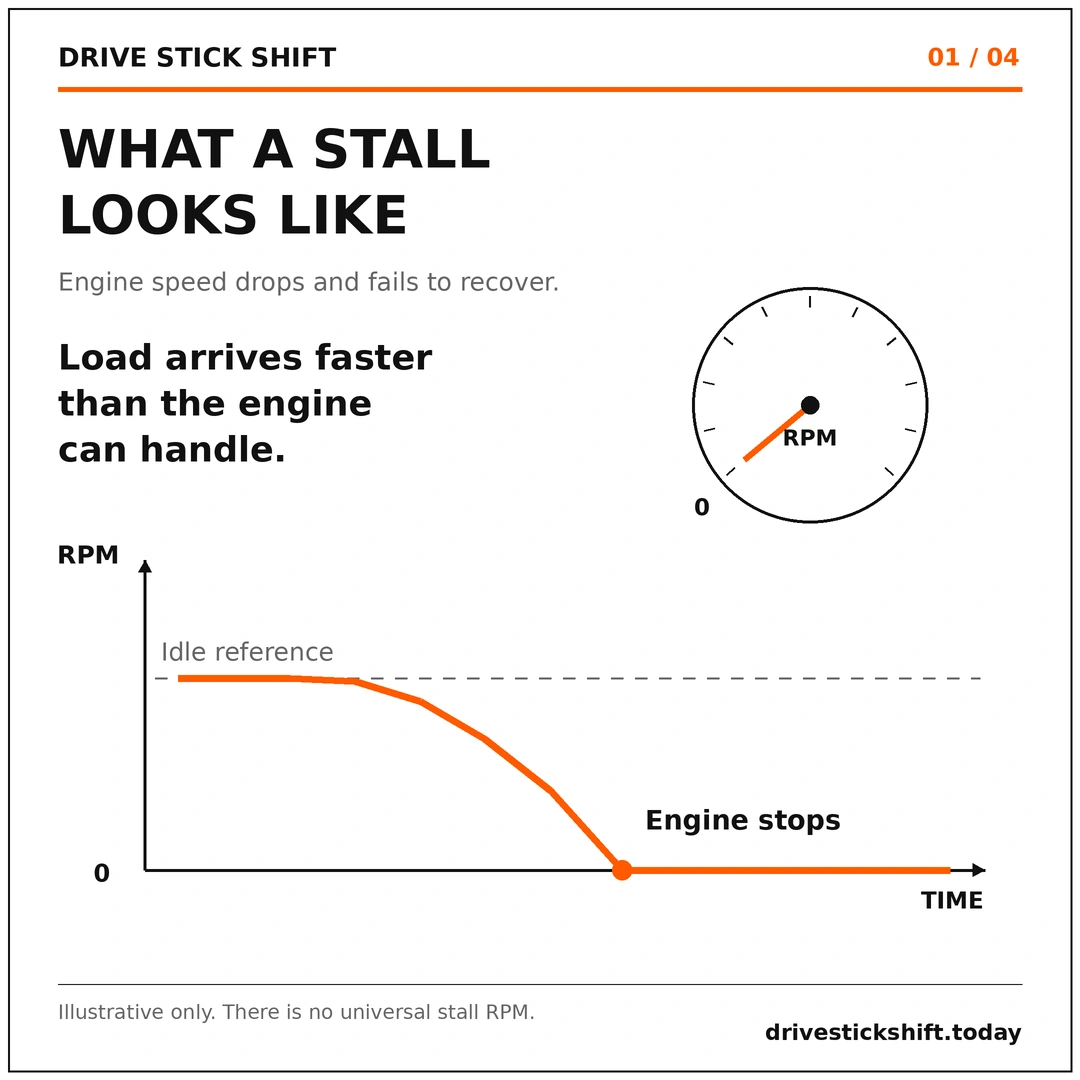
Connect that load too abruptly, without enough engine torque, and engine speed falls. You may hear the engine struggle and feel a shudder before it stops. The useful correction is to control how quickly the load arrives, while supplying enough gas for the situation.
Idle speed is a reference, not a universal stall threshold. An engine can dip below its normal idle and recover. If it cannot recover and stops turning, it has stalled. The tachometer illustration shows that sequence without assigning a made up RPM limit.
Key takeaways
- Slow the clutch release where the clutch starts taking load.
- Use first gear for ordinary starts from a standstill.
- Use the brakes to hold the car. Add gas to move it.
- Stalling in neutral or with the clutch fully down needs a different investigation.
Find Your Cause: What You Feel and What to Change
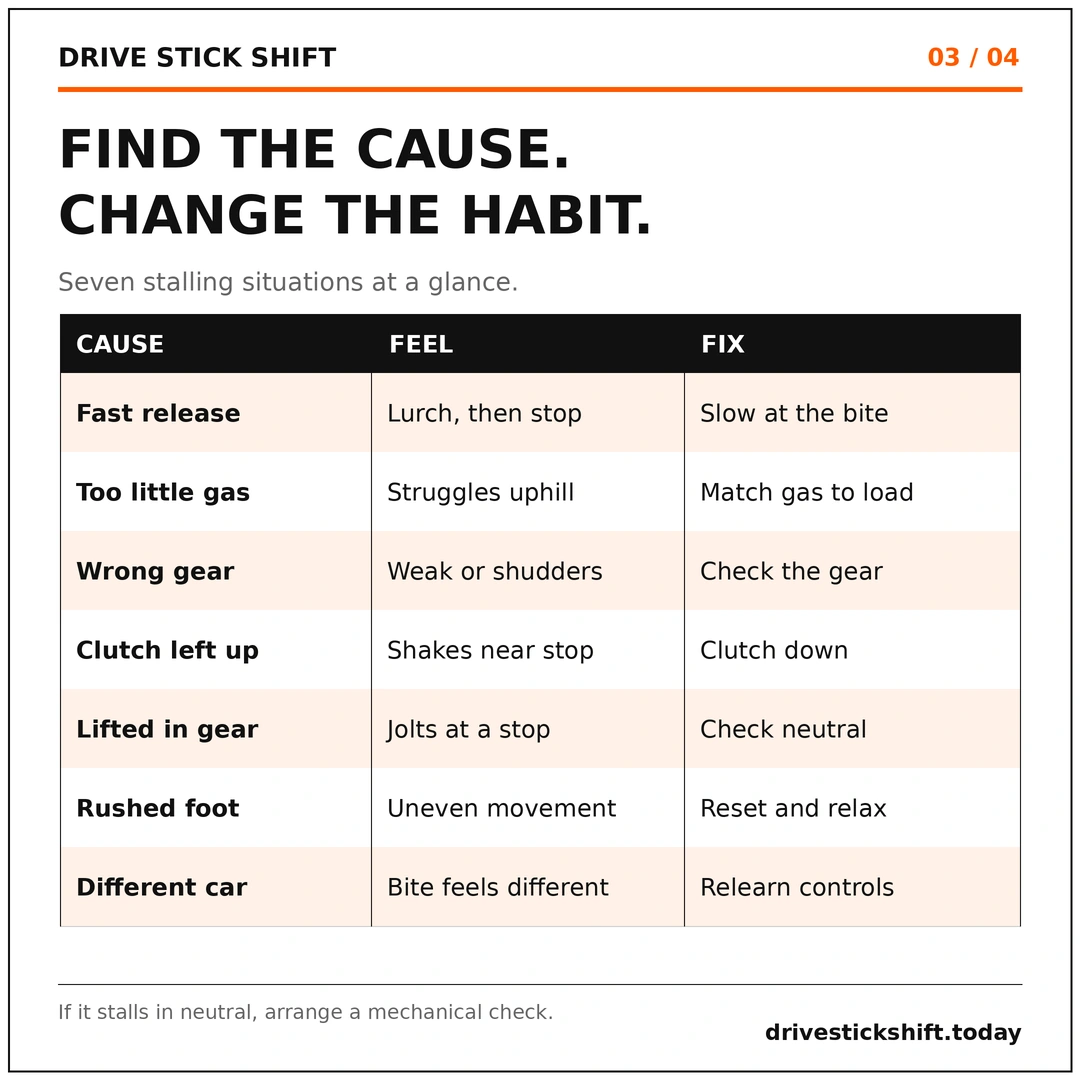
Use this table while parked, or have an instructor explain it before practicing. Keep your attention outside the car while moving.
| Cause | What you notice | What to change |
|---|---|---|
| 1. Clutch released too fast | A sudden lurch and sharp RPM drop during launch | Slow your release through the bite region. |
| 2. Too little gas for the load | The engine struggles on a hill or with extra load | Add modest, steady gas while controlling clutch engagement. |
| 3. Wrong gear | A difficult launch, or shuddering as you slow in a high gear | Check first before launching. Select a suitable lower gear when rolling. |
| 4. Braking without clutching in | Shuddering just before the car stops | Press the clutch fully before engine speed falls too low. |
| 5. Lifting the clutch while stopped in gear | A jolt as you relax your left foot at a light | Keep the clutch down, or select neutral before releasing it. |
| 6. Tension and an uneven left foot | Foot movement becomes abrupt when you feel rushed | Reset your seat position and make a controlled release. |
| 7. Unfamiliar car or changed conditions | Your familiar foot movement no longer works | Relearn the bite and throttle response. Investigate sudden changes. |
1. Releasing the Clutch Too Fast Past the Bite Point
Getting the car to move does not mean you can immediately take your foot off the clutch. At the first bite, the engine and transmission input shaft can still be turning at different speeds. Completing engagement abruptly can drag the engine down.
The fix: lift until you feel the clutch begin taking load, then make that part of the movement slower. As the car gathers speed and the clutch finishes engaging, continue releasing the pedal. Once fully engaged, take your foot off it.
The bite is a region of pedal travel, not one identical spot in every car. The diagram is conceptual: its zone widths do not represent a specific vehicle’s measurements.
Try it in Clutch Lab: You can practice the bite point and clutch timing in our Clutch Lab simulator.
Instructor tip: change the speed of your clutch release where the car responds. Slowly lifting through the empty travel, then rushing through the bite, misses the part that matters.
2. Using Too Little Gas for the Load
A launch that works on level pavement may struggle uphill or with more passengers. The engine must provide enough torque for the demand. An engine driven AC compressor can add load too, although the engine computer normally compensates for accessory loads.
The fix: add a modest, steady amount of gas as you bring the clutch through engagement. Adjust to the car and conditions instead of chasing one universal launch RPM. If the engine starts laboring during a slow practice launch, press the clutch down and brake to reset.
Some cars can move at idle on flat ground, and some engine controls add torque as load increases. That can help a bite point exercise, but it does not guarantee a successful launch in every car. Use the procedure in Bite Point First, Gas Second (forthcoming).
On a hill, hold position with the brakes and use the parking brake or your vehicle’s hill assistance as appropriate. Do not hold the car stationary by balancing gas against a slipping clutch.
3. Starting in the Wrong Gear or Staying in a High Gear Too Long
First gear gives the engine more mechanical advantage at the wheels than third gear. Accidentally selecting third makes an ordinary launch much harder. Adding lots of gas and slipping the clutch longer is an expensive habit to build around a missed gear.
The fix: while stopped with the clutch fully down, deliberately select first using your car’s shift pattern. If a launch feels unusually weak, stop safely and check the gear instead of forcing the car onward.
The same mismatch happens when you slow almost to a stop in a high gear. Shift to a suitable lower gear if continuing, or press the clutch fully down as you finish stopping. Do not force first gear at an unsuitable road speed.
4. Braking to a Stop Without Pressing the Clutch
With a gear selected and the clutch engaged, wheel speed and engine speed are linked. Braking toward a complete stop eventually pulls engine speed too low if you leave that connection intact.
The fix: brake normally, then press the clutch fully before the engine begins struggling at low speed. Continue braking to a stop. There is no single road speed for doing this in every gear and car.
You do not need to coast with the clutch down from the moment you touch the brake. You need to disconnect it before engine speed becomes unsustainably low. Practice this sequence somewhere quiet, with an instructor if you cannot yet judge the timing.
5. Releasing the Clutch While Still Stopped in Gear
You stop correctly, keep first selected, and then relax your left foot. If the brakes hold the wheels still as the clutch engages, the engine can stall. Without enough brake pressure, the car may move unexpectedly instead.
The fix: make your stopped state deliberate. Keep the clutch fully down if remaining in gear for an immediate departure. If waiting in neutral, select neutral before lifting your left foot. Keep the brake applied either way.
Common mistake: a stopped car is not automatically a car in neutral. Check your gear before releasing the clutch. Parking the car and switching the engine off is a separate procedure.
6. Nerves Make Your Left Foot Rush
Feeling hurried can turn a controlled release into an abrupt movement. Treat the foot movement as the thing to correct, rather than deciding you need a bigger burst of gas every time someone waits behind you.
The fix: adjust the seat so you can press the clutch all the way down with a comfortably bent knee and without stretching. Use the ball of your foot on the pedal. Keep your upper body supported instead of bracing against the clutch.
Near the bite region, lightly supporting your heel on the floor may help if the pedal position and your leg length allow it. Let the heel move when needed. Do not force it down if that prevents full pedal travel or a smooth release.
Before another attempt, secure the car with the brake, take a breath, and reset. Practice the recovery sequence as well as the launch so a stall does not turn into a rushed second attempt.
During a student’s second lesson, we commonly start driving in light to moderate traffic. With attention split between pedestrians, cars, scooters, and cyclists, pedal control can become less consistent. I often see the right foot start over-revving because the student wants to get moving. That extra gas can lead to more clutch slipping rather than a smoother launch. The goal is to keep watching the road while giving the clutch the same controlled release practiced in the quieter area.
7. The Car or Conditions Feel Different
A different bite height, throttle response, or flywheel can make familiar movements less effective. A flywheel with lower rotational inertia stores less energy at the same speed, leaving less reserve during clutch engagement. That can make a modified car less forgiving.
A cold engine may also idle differently. Follow the owner’s manual for starting and driving away, and avoid high revs while cold. Normal cold behavior should not be used to explain away repeated stalling or rough running.
The fix: recalibrate on level ground in a safe practice area. Learn where the clutch starts taking load, then add suitable gas. A high bite point alone does not prove the clutch is worn. A sudden change in bite position, sticking pedal, or persistent judder deserves inspection.
When Stalling Is a Car Problem
If the engine stalls while idling in neutral, the launch technique above cannot explain it. Repeated stalling with the clutch fully down also calls for investigation. Air metering faults, intake leaks, idle control problems, ignition faults, and fuel delivery problems are possible categories, not a diagnosis.
Tell the mechanic whether it happens cold or warm, whether AC changes it, and whether the transmission is in neutral or the clutch is fully down. Note warning lights and any recent repairs. A fault code can help, but the absence of a warning light does not prove the car is healthy.
If it stalls unpredictably while moving, stop practicing in traffic and arrange an inspection. If it will not restart, secure the car, use hazards as appropriate, and get help.
A Simple Reset After a Stall
- Brake: keep the car from rolling.
- Clutch down: press it fully and select neutral.
- Restart: follow your car’s starting procedure.
- Check: select first, check traffic and pedestrians, then move when safe.
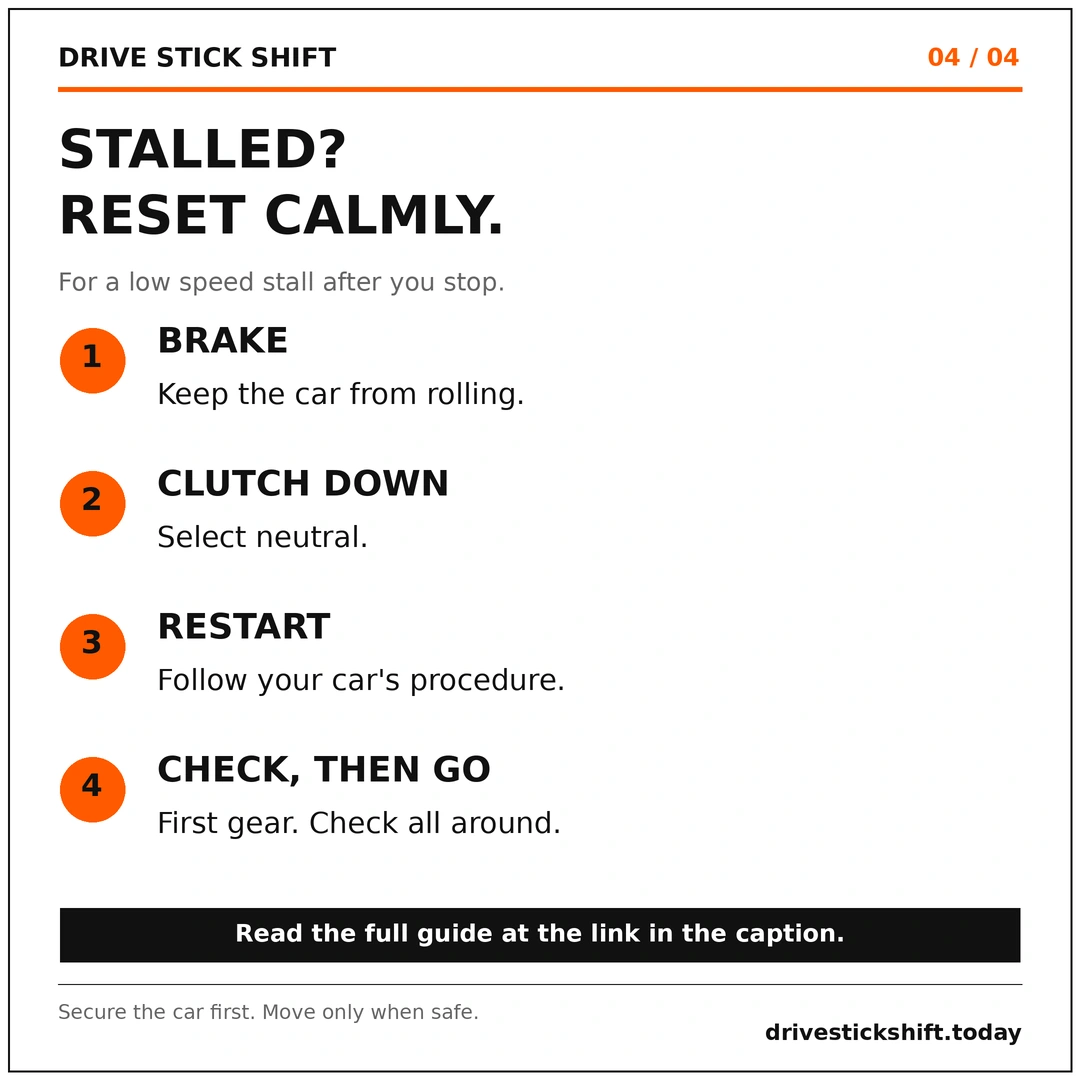
Some cars restart automatically when you press the clutch after a stall. Others require the key or start button. Learn your car’s procedure while safely parked. See How to Recover From a Stall in Traffic (forthcoming) for the full routine.
Frequently Asked Questions
Why does my manual car keep stalling when I pull away?
Check first gear, then focus on clutch release speed and gas for the load. If the engine idles normally until the clutch begins engaging, start with those checks. Persistent problems despite controlled technique need inspection.
Can a manual car stall with the clutch fully down?
Yes. An engine fault can stop it independently of clutch engagement. A clutch that fails to disengage fully can also cause problems, so confirm pedal travel and have recurring symptoms checked.
Does more gas always stop a manual from stalling?
No. More gas cannot reliably fix the wrong gear or an abrupt clutch release. Excessive revs combined with prolonged slipping create unnecessary clutch heat.
Should I keep my heel on the floor?
Only when it helps smooth control and still allows the required travel. Some drivers can support the heel near the bite; others need more leg movement. Full pedal control comes first.
Is stalling bad for the clutch?
A stall by itself does not prove clutch damage. Avoid turning each attempt into a long, high RPM slip, and investigate persistent judder or other new symptoms. Read Is Stalling Bad for Your Car? (forthcoming) for the fuller explanation.
For more manual driving guidance, explore Driver Resources. Practice pedal timing in Clutch Lab, or book a manual lesson in NYC and the tri state area for feedback in the car.
Sources and Technical References
- New Zealand government Drive: stall causes and safe recovery
- Ford owner manual: manual transmission
- Hyundai owner manual: manual transmission operation
- Mazda3 2023 owner manual: manual transmission
- ZF SACHS: passenger car clutches
- ZF SACHS: clutch slipping
- ACT: high inertia flywheel and stalling
- ACT: clutch technical FAQ
- Mazda3 2023 owner manual: starting the engine
- DENSO: mass air flow sensors
- DENSO: manifold absolute pressure sensors
- Honda Civic 2025 owner manual: manual Auto Idle Stop
- Book Learn Pass: clutch control
- Ford PCED: idle and stalling symptom charts
- Ford OBD system operation summary
