
Quick answer: Engine braking is the slowing effect you get when you release the gas while remaining in gear with the clutch engaged. The moving wheels turn the engine, and its resistance helps slow the car. A suitable lower gear usually increases that effect. Use it alongside the brakes, especially on long descents.
What is engine braking doing in a manual car? It is using the engine’s resistance through the existing connection to the wheels. You do not have to downshift to make it happen. Simply lifting off the gas while staying in gear can produce it.
This guide concerns ordinary modern, fuel injected gasoline cars with synchronized manual gearboxes. Diesel truck retarders, hybrids, and electric regenerative braking involve additional systems.
Key takeaways
Lifting off while in gear already produces engine braking.
A lower gear generally gives stronger slowing at the same road speed.
Fuel injection can stop during eligible deceleration conditions.
Use the brake pedal when you need stronger slowing or a clear brake light signal.
What Is Engine Braking? Follow the Power Path
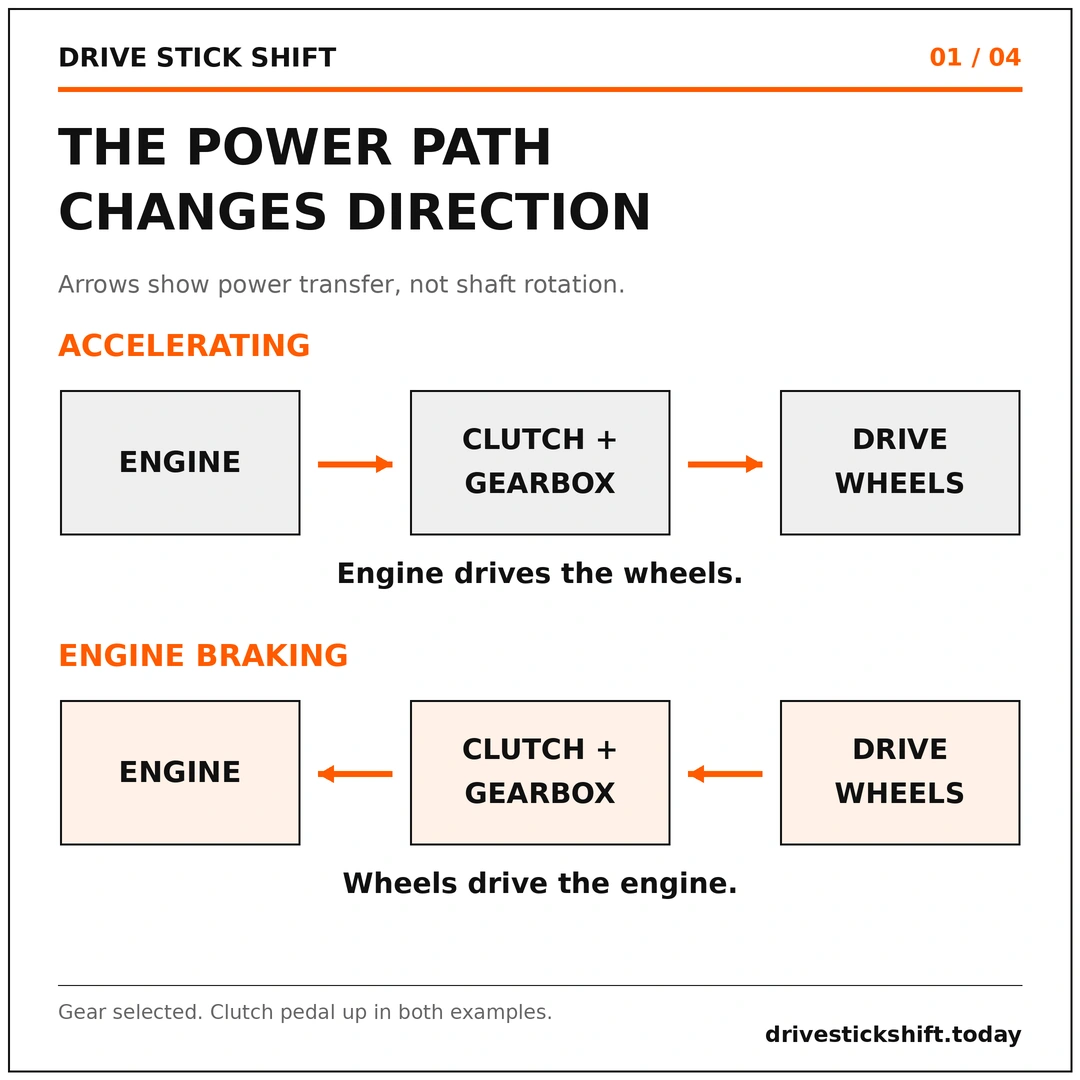
Under acceleration, the engine sends power through the engaged clutch, gearbox, and final drive to the drive wheels. During engine braking, that power flow reverses: the drive wheels supply power through the driveline to keep the engine turning against its resistance.
The engine still rotates in its normal direction. The arrows in the diagram show the direction of power transfer, not a reversal of crankshaft rotation. The clutch pedal is up and a gear is selected in both examples.
Pressing the clutch fully down disconnects the engine from that path. Selecting neutral also interrupts power transfer through the gearbox. The car still encounters air resistance and rolling resistance, but it no longer gets the same engine braking through the wheels.
Try the controls in Clutch Lab: Explore how clutch engagement connects the engine and wheels in our Clutch Lab simulator. To feel how that connection responds in a real car, practice engine braking in a stick shift lesson, with guidance on your gas, brakes, and gear choice.
Where the Engine’s Resistance Comes From
In a typical gasoline engine, releasing the accelerator closes the throttle substantially. The pistons still move, but drawing air past that restriction requires work. The low pressure in the intake manifold is often described as vacuum; the associated work is called a pumping loss.
Mechanical friction also resists motion, and the engine continues driving equipment such as its oil pump. The moving car supplies the energy needed to overcome those losses. Engine design and control strategies affect how much resistance you feel.
Compression needs one correction: compressing the cylinder charge takes work, but much of that energy pushes the piston back during the following expansion stroke. Compression alone does not explain all the slowing. Pumping losses, friction, and other losses give the useful overall picture.
That distinction matters when comparing an ordinary gasoline car with a compression-release truck brake. The truck system deliberately changes the valve operation so much less compression energy returns to the piston. More on that below.
Why a Lower Gear Usually Slows the Car More
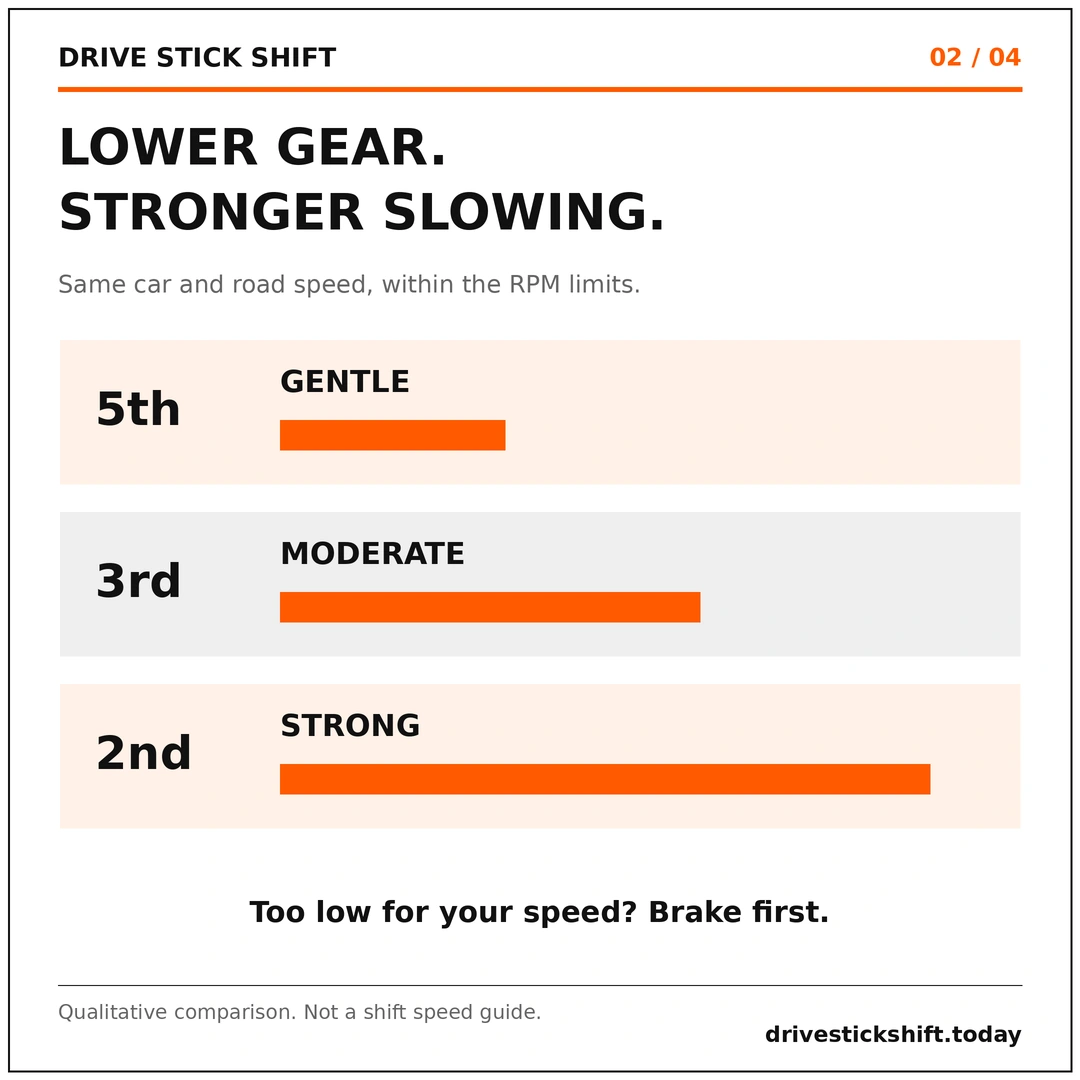
At the same road speed, a lower gear turns the engine faster. The gear ratio also changes how the engine’s resisting torque acts at the wheels. Together, those effects generally make the car slow more strongly in a suitable lower gear.
You can often feel this without changing gears: lifting off in first produces a more noticeable response than lifting off in a high cruising gear. That does not mean first is an appropriate gear to select at highway speed.
The illustration compares fifth, third, and second qualitatively. It is not a stopping-distance chart or a recommendation to select those gears at any particular speed. Each comparison assumes the same car and road speed, within the engine’s permitted RPM range.
Instructor tip: choose a gear because it suits your speed and the road ahead. A louder engine is not proof that you chose a better gear. Brake first if you need to reduce speed before a safe downshift.
During our early starting exercises, students often discover engine braking before they know its name. They lift off the accelerator in a low gear and feel the car give a noticeable tug. That becomes a chance to connect what their right foot is doing with how the car responds.
It also leads into our discussion of upshifting. If a low gear produces more slowing than you want, and your road speed and conditions suit the next gear, an upshift may be appropriate. We work on smooth accelerator inputs too, rather than treating every uncomfortable tug as a reason to change gears.
Does Engine Braking Use Fuel?
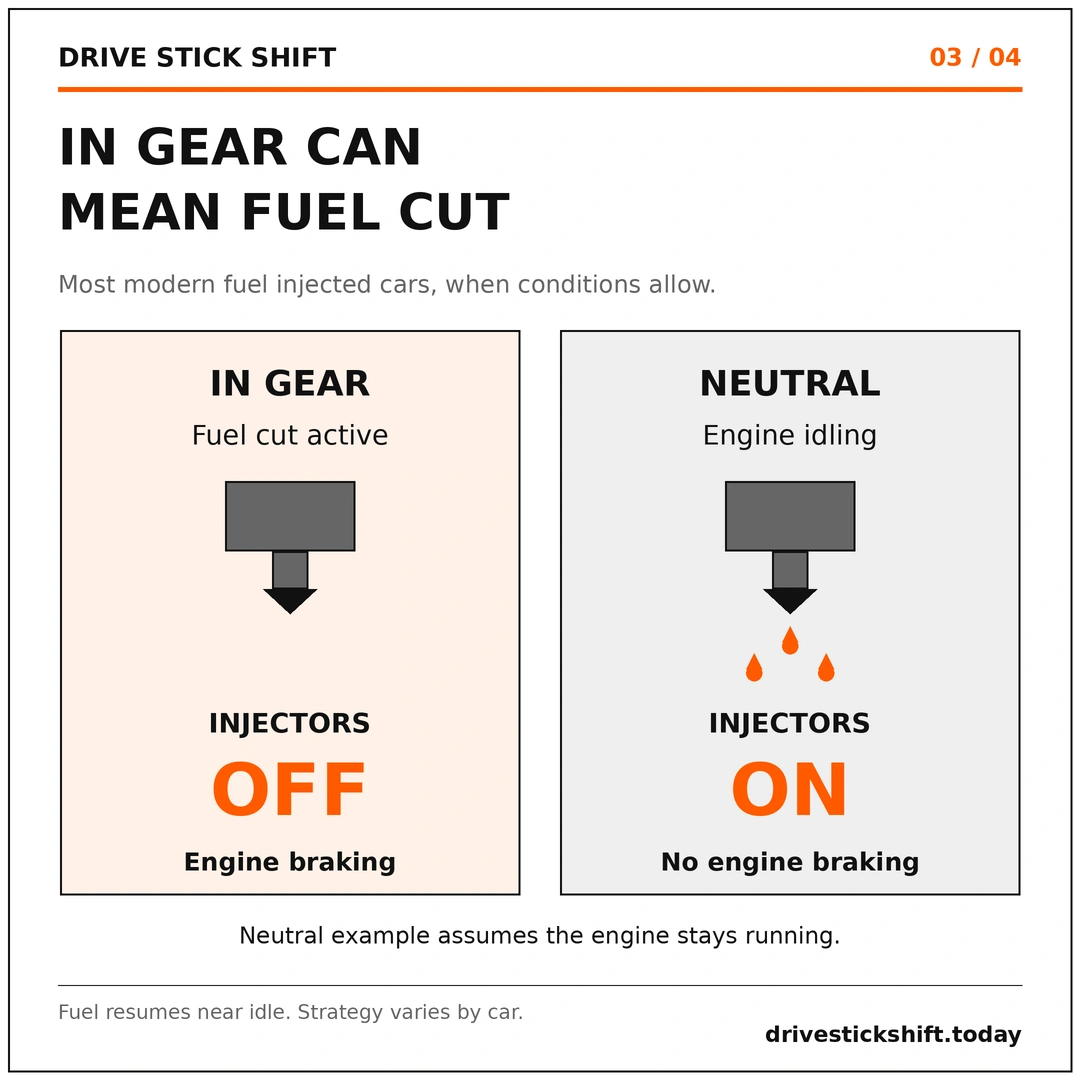
Most modern fuel injected cars can stop injecting fuel during suitable closed-throttle deceleration. This is called deceleration fuel cut off, often shortened to DFCO. Ford also uses the term deceleration fuel shut off.
With the clutch engaged and a gear selected, the moving wheels keep the engine turning. It does not need combustion to maintain that rotation while the car is supplying enough power through the driveline.
Fuel cut is conditional. The engine computer considers factors such as engine speed, temperature, and its calibration. Emissions control can also affect fueling. There is no single RPM threshold that applies to every car, and releasing the gas does not guarantee that the injectors are off immediately or continuously.
As engine speed approaches the car’s fuel-resumption threshold, injection returns to keep the engine operating smoothly. That happens before the engine would simply stop turning. Opening the accelerator also calls for fueling again.
| Situation | What turns the engine? | Fuel behavior | Engine braking? |
|---|---|---|---|
| In gear, gas released, fuel cut active | The moving wheels through the driveline | Injectors are temporarily off. | Yes. |
| In gear, gas released, fuel cut not active | The wheels remain connected to the engine | Fueling depends on the operating conditions. | It can still occur. |
| Neutral, engine running at idle | Combustion keeps the engine idling | Fuel is used to maintain idle. | No engine braking through the wheels. |
The neutral comparison assumes the engine remains running. An automatic stop-start system that shuts it down is a separate case. Older carbureted engines also differ from the fuel injection behavior described here.
Do not turn this into a claim that a particular downshift always saves a particular amount of fuel. Route, speed, how much slowing you need, and subsequent acceleration all matter. The practical lesson is that neutral is not automatically a fuel-saving setting.
When Engine Braking Helps
Long Downhills
On a long descent, gravity keeps adding speed unless something holds the car back. A suitable lower gear allows the engine to share that work with the wheel brakes. This can reduce the demand that otherwise builds heat in the brakes.
Slow to a suitable speed and choose the gear before the descent becomes difficult to manage. Use the brake pedal as needed to control speed. Do not let the car run away while waiting for engine braking to do everything.
Gradual Slowing in Ordinary Driving
If traffic ahead is easing off and you have space, smoothly releasing the accelerator can begin reducing speed while you assess what comes next. Stay ready to brake. You do not need to work down through every gear each time you approach a stop.
As road speed falls, either select a suitable gear for continuing or press the clutch fully down before the engine struggles as you finish stopping. If that timing is unfamiliar, see Why Do Manual Cars Stall?
Slippery Roads Require Extra Care
Engine braking still uses the tires’ available grip. An abrupt downshift or clutch release can suddenly load the drive wheels and cause a skid. It does not become safer simply because you did not press the brake pedal.
Reduce speed early, keep inputs smooth, and follow your owner’s manual. Do not deliberately select a much lower gear for aggressive slowing on wet, snowy, or icy pavement. Some manufacturers specifically warn against sudden engine braking in these conditions.
The lesson aha moment: When I stop to explain engine braking, I often point out that the student has already been doing it without realizing. They may have lifted off before a turn or a speed bump and found that the car slowed enough for that moment. We still use the brakes whenever more slowing is needed.
Now we put a name to that familiar feeling. After that explanation, when I ask the student to engine brake, they know what action I mean. You can feel that connection during a stick shift lesson instead of trying to learn it from a diagram alone.
Brake Lights: The Part Drivers Behind You Cannot Hear
Ordinary lift-off engine braking in a conventional manual car generally does not illuminate the brake lights. A following driver may see the gap shrinking without the usual signal that you are slowing.
When slowing in traffic, a light brake application can provide that signal while helping control speed. Use the brakes to produce the slowing you actually need; do not wait for engine braking alone if the situation calls for a firmer reduction.
Some vehicles have additional systems that illuminate the lamps during other forms of deceleration. Do not assume your manual does. In an urgent stop, concentrate on braking and steering rather than completing a sequence of downshifts.
Common mistake: trying to keep your foot off the brake at all costs. Engine braking is a useful contribution to speed control. It is not a reason to withhold the clearer signal or stronger slowing that the brake pedal provides.
Does Engine Braking Damage the Engine or Clutch?
Ordinary engine braking within the car’s permitted operating range is part of normal driving. Manufacturer manuals explicitly recommend suitable downshifts for descending hills. That is different from selecting a gear that would drive the engine beyond its allowed speed.
With a healthy clutch fully engaged, engine braking does not require continuous clutch slipping. The avoidable heat comes from using a partially engaged clutch to absorb a large mismatch in speed. Make downshifts controlled, and do not hold the clutch halfway up to create a prolonged slowing effect.
Myth: any increase in engine RPM during slowing means damage. Fact: RPM should rise when you select a suitable lower gear at the same road speed. The questions are whether that speed is permitted and whether the change is smooth.
The companion guides Engine Braking vs Brakes: What Wears Out and How to Downshift Smoothly will cover wear and technique in more detail. Both are forthcoming in this series.
Engine Braking vs a Jake Brake
A compression-release brake, commonly associated with the Jake Brake name, is a specialized engine retarder used on trucks. It opens exhaust valves near the top of the compression stroke, releasing compressed air instead of letting it return much of its energy to the piston.
That system is different from simply lifting off the accelerator in your gasoline manual. An exhaust brake is another truck system, using exhaust restriction to increase resistance. Neither description means an ordinary passenger car needs special equipment for normal engine braking.
Roadside engine-brake signs often concern noise from truck braking systems, particularly inadequate muffling. Exact restrictions depend on the sign and local rules. Do not interpret a noise-related sign as a universal instruction to coast downhill in neutral.
A Simple Engine Braking Routine
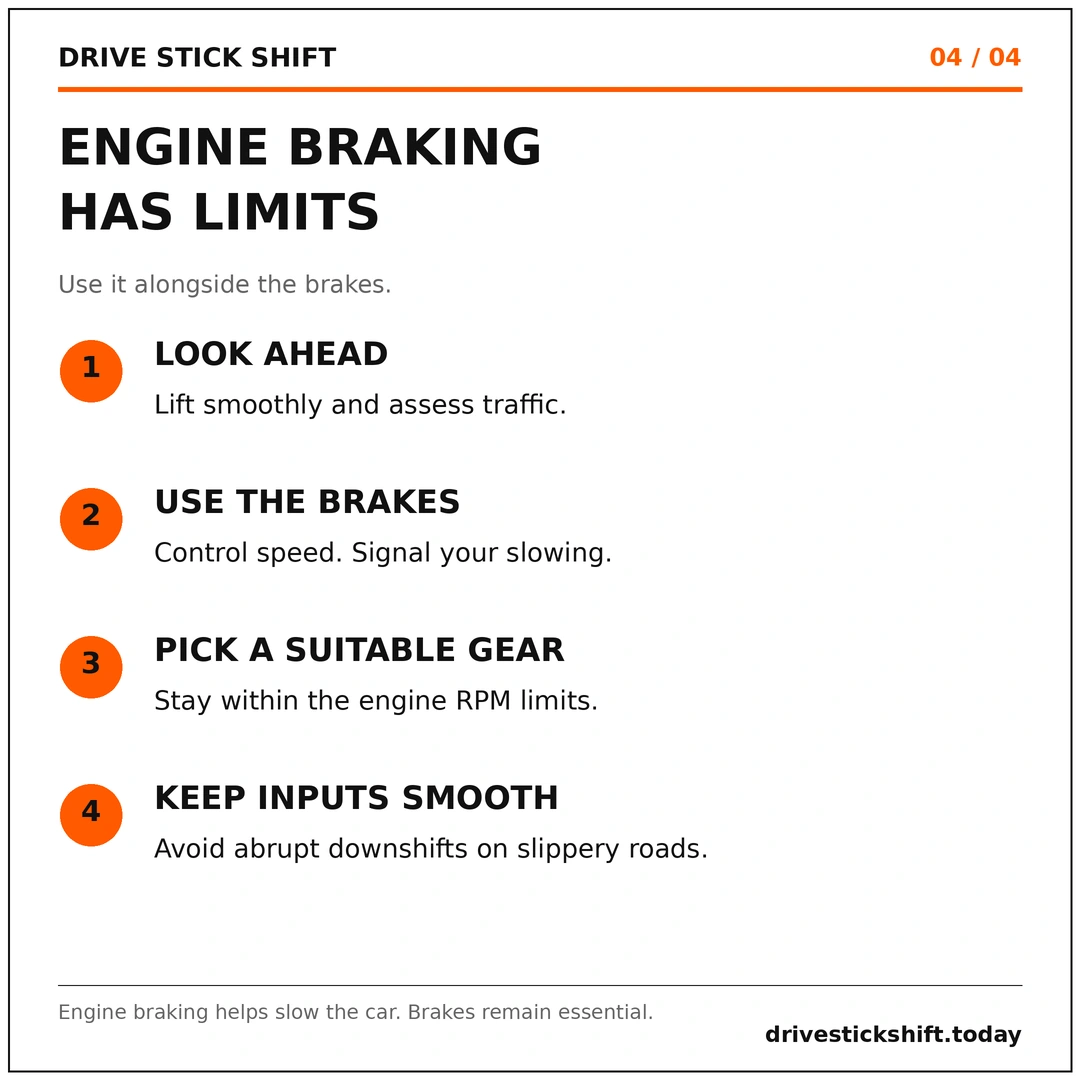
- Look ahead. Decide how much slowing the road and traffic require.
- Lift smoothly. Stay in your current gear and feel the available slowing.
- Brake as needed. Control speed and give following traffic a clear signal.
- Choose a suitable gear. Downshift only if the speed and conditions suit it.
- Finish the stop correctly. Press the clutch fully before engine speed falls too low.
Practice noticing the effect in a safe, quiet setting without staring at the tachometer. Start with lifting off in a gear you are already using. More complicated downshifts can wait until your ordinary braking and clutch timing are consistent.
Frequently Asked Questions
Do I have to downshift to engine brake?
No. Lifting off while remaining in gear with the clutch engaged already produces engine braking. A suitable downshift can increase it, but is not required every time you slow.
Can the engine turn without using fuel?
Yes, during eligible deceleration fuel cut conditions. The moving wheels turn the engine through the engaged driveline. Fuel injection resumes when the car’s control strategy calls for it.
Is second gear always best for a downhill?
No. The suitable gear depends on road speed, gradient, grip, and the car’s gearing and RPM limits. Slow down before selecting a lower gear, and use the brakes as needed.
Does pressing the clutch stop engine braking?
Fully pressing the clutch disconnects the engine from the transmission, removing its normal braking contribution through that path. Air resistance and rolling resistance remain. The brake pedal remains available.
Is engine braking the same as regenerative braking?
No. Regenerative braking uses an electric machine to recover energy, commonly into a battery. Ordinary engine braking in a conventional gasoline manual does not recharge a traction battery that way.
The planned guide Coasting in Neutral will examine that habit further. For more instruction, explore Driver Resources. Want to feel engine braking for yourself? Book a stick shift lesson in NYC and the tri state area. We can work on recognizing the slowing effect, choosing a suitable gear, and making the transition to the brakes smoothly.
Sources and Technical References
- MIT: internal combustion engine pumping losses
- NHTSA: engine friction and gas exchange losses
- Banks Power: compression and expansion energy
- Toyota training: injection duration controls
- Ford: gasoline OBD operation summary
- EPA research: transient fueling and DFCO
- Hyundai: manual transmission and downhill technique
- Mazda3 2024: manual transmission guidance
- ZF SACHS: clutch slipping and heat
- NHTSA: stop lamp activation interpretation
- Cummins: compression release engine brake
- Ford: diesel exhaust brake
- Colorado DOT: engine brake noise
- Ford: hybrid braking and regeneration
