
By Anton, a manual driving instructor with 16+ years of teaching experience.
This guide covers modern fuel injected cars with synchronized manual gearboxes. Start with upshifts, then use the same idea to understand downshifts.
Why your car jerks when shifting gears
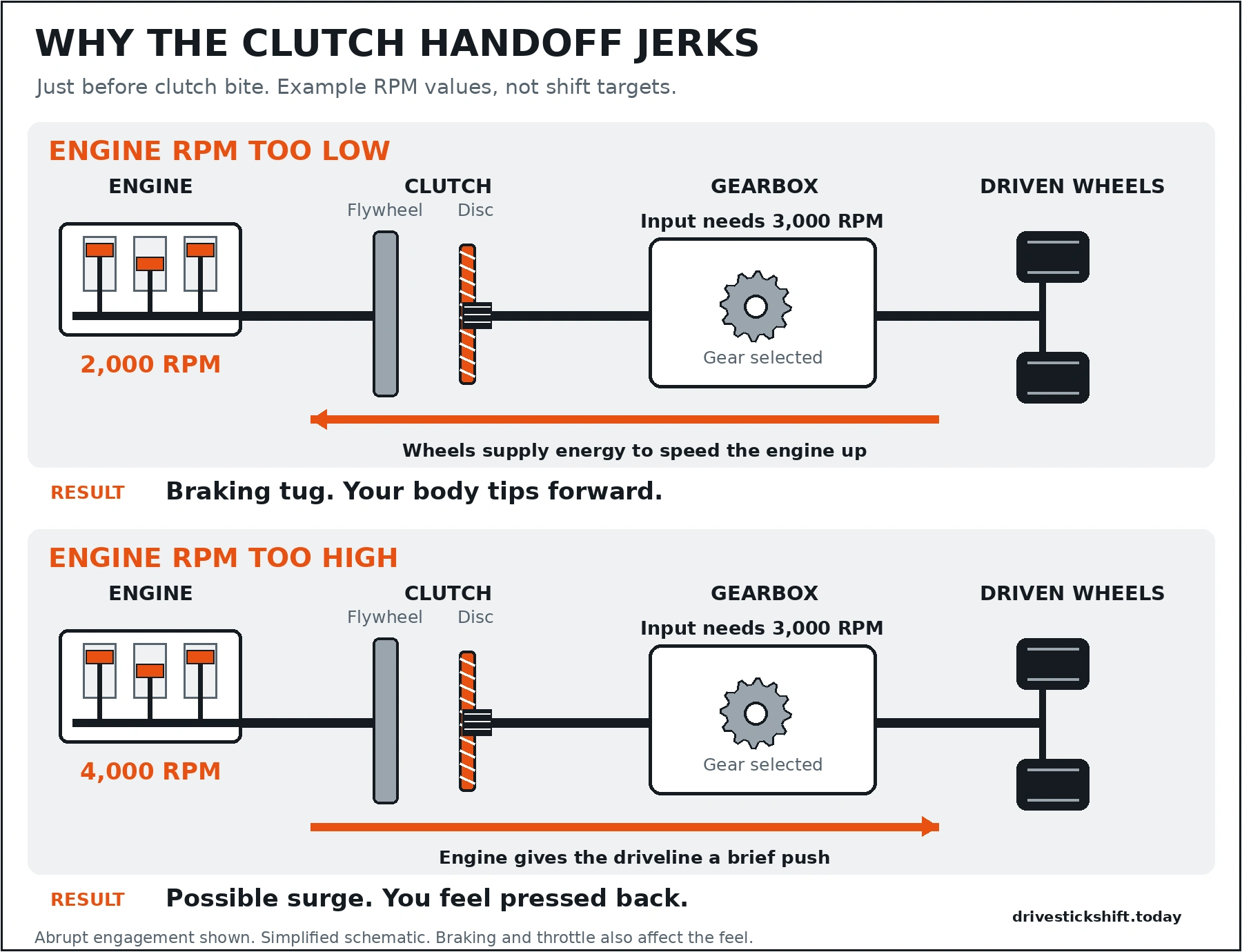
Think of a smooth shift as a handoff. The engine and the transmission need to be turning at compatible speeds when the clutch reconnects them. If they are far apart, the clutch has to pull their speeds together. Do that suddenly and you feel the correction.
The clutch can cushion a small mismatch through brief, controlled slip. The goal is to give it less correcting to do, not to hide every mistake with a long pause at the bite point. Abrupt clutch engagement and excessive slipping are both habits to avoid. Ford’s manual transmission precautions explain why smooth engagement matters.
Pay attention to when the jolt happens. A head nod as you lift off the gas can come from the interruption in acceleration. A bump precisely as the clutch bites points more directly toward the handoff. Shaking after the clutch is fully up needs a different diagnosis.
Start with upshifts: let the RPM come down
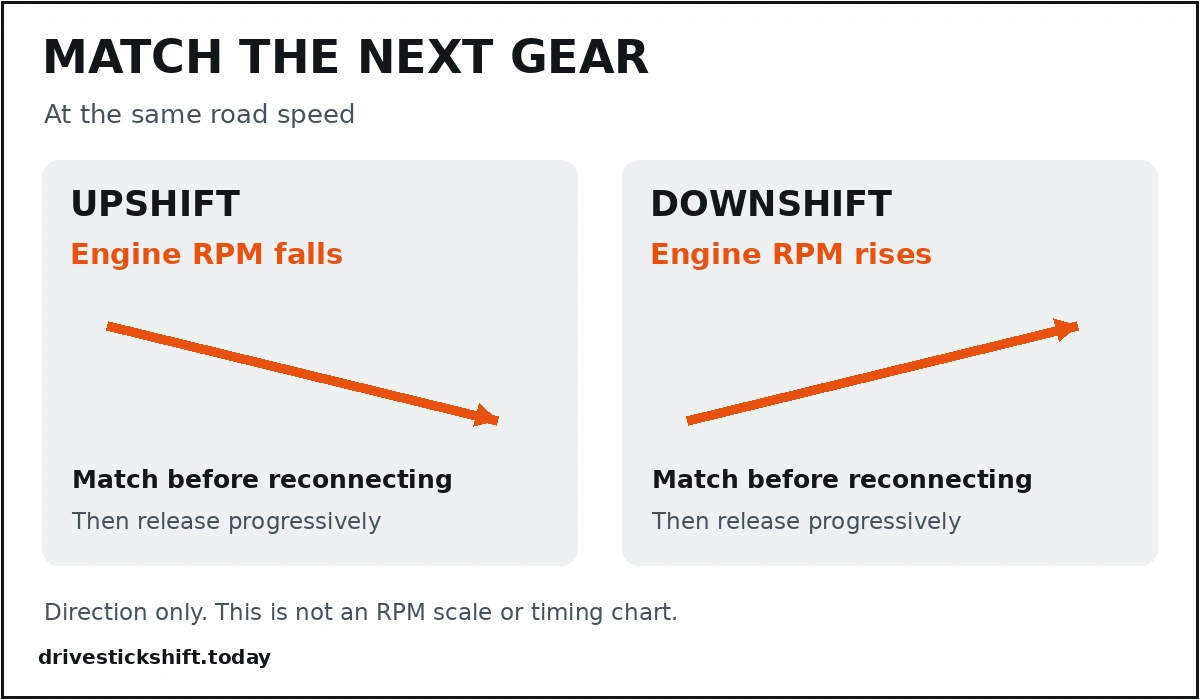
At the same road speed, a higher gear requires less engine RPM. When you change from second to third, for example, the engine normally needs to slow down before the clutch reconnects. There is no universal RPM drop or fixed waiting time: the gear ratios, changing road speed and the car’s engine response determine the target.
Rev matching means bringing engine speed close to the speed required by the next gear at the moment of reconnection. People usually use the term for a throttle blip on a downshift, but matching speeds matters in both directions. Honda’s rev match system explanation describes both upshift and downshift assistance.
Method 1: let the revs fall, then let the clutch finish the match
- Ease off the gas as you press the clutch fully down.
- Select the next higher gear without forcing the shifter.
- Let engine speed fall toward what the new gear needs.
- Bring the clutch through engagement progressively, allowing it to smooth the remaining small difference.
- Finish releasing the clutch and smoothly resume the gas.
This is clutch assisted speed matching. Your left foot controls how gently the two sides reconnect. It does not mean holding the clutch halfway for the whole acceleration. Once it has joined the engine and transmission, take your foot off the pedal.
Method 2: blend a little throttle into the handoff
If the revs fall below the target before the clutch bites, a small, coordinated return to the gas can support engine speed as you reconnect. Think ease the clutch through engagement while gently bringing power back, rather than clutch up, sudden jab of gas.
This can make the return to acceleration feel more continuous. The amount of overlap depends on the car and the speed difference. It is a light transition, not permission to rev hard against a slipping clutch.
If the revs are still too high, adding gas is the wrong correction. Ease off and give them time to settle. If they consistently fall too low, work on the timing and a smaller throttle adjustment rather than making the clutch do more work.
Downshifts: bring the RPM up before reconnecting
A lower gear needs more engine RPM at the same road speed. If you press the clutch, select the lower gear and let the engine drop toward idle, you have made that gap larger.
As you release the clutch, the moving car must then spin the engine faster. That takes energy from the car’s motion and creates a braking effect. An abrupt correction can feel like someone briefly tapped the brakes. A throttle blip raises engine speed beforehand so the clutch has less catching up to do. Driver61 explains the reason for matching revs on downshifts.
For ordinary practice, choose a dry, straight, clear location and a modest speed with an instructor if needed. Brake to an appropriate speed first. Practice a single downshift when you do not need continuous braking; do not release needed brake pressure just to reach for a blip. Combining braking and blipping is a separate skill.
- Choose a lower gear that is appropriate for your current speed.
- Ease off the gas and press the clutch fully down.
- Select that lower gear.
- With the clutch still down, briefly add gas to raise engine RPM toward the new target.
- Release the clutch progressively while the revs are still near that target.
- Once connected, use the gas or brakes according to what the road requires.
Timing matters as much as the size of the blip. If you blip early and pause, the revs can fall away before you reconnect. Improve the coordination before simply adding a bigger blip. The National Auto Sport Association’s driver instruction article discusses this timing problem in a track context.
Did your body tip forward or press into the seat?
Separate the car’s movement from your body’s movement. When the car slows suddenly, your body tends to tip forward. When the car surges forward, you can feel pressed back into the seat. Those are opposite descriptions of the same event depending on whether you mean the car or the occupant.
| At clutch engagement | Likely speed mismatch | Next correction |
|---|---|---|
| The car tugs back; your body tips forward. Engine RPM is pulled upward. | The engine was turning too slowly for the selected gear and road speed. | On a downshift, improve the blip or reconnect before it fades. On an upshift, avoid letting the revs fall too far. |
| The car briefly surges; you feel pressed into the seat. Engine RPM is pulled downward. | The engine may have been turning too quickly, or you may have added too much gas. | Use a smaller blip or less throttle. If revs are above target, allow them to settle before reconnecting. |
| Very little disturbance; RPM settles without a sharp correction. | Engine speed was close to the target and the clutch handoff was controlled. | Repeat the timing rather than chasing a particular pedal position. |
These are diagnostic clues, not guarantees. Braking, throttle changes, road slope and driveline movement can change what you feel. The brief RPM correction as the clutch catches is useful supporting evidence, but keep your eyes on the road rather than watching the tachometer. An instructor can help connect the sound, feel and timing.
Practice in the Clutch Lab simulator.
When the cause may be the car
A single bump that improves with coordination is different from repeated shuddering, grinding or slipping. Do not assume every rough shift is the driver’s fault.
| What you notice | What needs checking |
|---|---|
| Repeated shuddering as the clutch engages, even with careful inputs | Clutch friction surfaces, contamination, flywheel or pressure plate problems, and engine or transmission mounts. |
| A pronounced clunk when power comes on or off | Mounts and excessive movement or play in the driveline. A clunk alone does not identify the failed part. |
| Grinding or difficulty selecting a gear with the clutch fully down | Clutch release, the specified transmission fluid and synchronizer condition. Do not force the lever. |
| RPM rises under load without the matching increase in road speed, with the clutch fully released | Possible clutch slip. Arrange diagnosis instead of repeatedly testing it with hard acceleration. |
Centerforce’s diagnostic guide lists several possible sources of clutch shudder, including faults outside the clutch itself. TREMEC’s technical FAQ distinguishes clutch actuation, synchronizer and fluid problems that can contribute to grinding.
A blip with the clutch fully down primarily changes engine speed. It does not repair a worn synchronizer or a clutch that will not disengage. Synchronizers perform a separate speed matching job inside the gearbox, as explained in TREMEC’s synchronizer guide.
Frequently asked questions
Should I add gas while releasing the clutch on an upshift?
A small, coordinated return to the gas can help if engine speed would otherwise fall below what the higher gear needs. If RPM is still too high, more gas increases the mismatch. Use light overlap when needed and finish releasing the clutch instead of holding it partially engaged.
Can I downshift smoothly without blipping the throttle?
Yes. At an appropriate road speed, controlled clutch engagement can bring the engine up to the lower gear’s required RPM. A well timed blip reduces the correction the clutch has to make; simply drawing out the slip is not the goal.
Why does my car jerk even after I blip the throttle?
The blip may be too small, too large or too early. You need the revs near the target when the clutch reconnects, not merely a rev rise somewhere during the shift. An abrupt clutch release or a mechanical fault can also cause a jolt.
Does rev matching stop engine braking?
No. It reduces the sudden speed correction as the clutch reconnects. Once you are in gear with the clutch fully released and the gas off, engine braking can still slow the car; see What Is Engine Braking? How It Works and Why Manual Drivers Use It.
Does an automatic rev match system do the whole shift for me?
No. In a manual car, you still operate the clutch and select the gear. The system assists with engine speed, and its behavior and limitations depend on the model, so check your owner’s manual.
If your issue starts before you are moving, read Why Do Manual Cars Stall? 7 Causes and the Fix for Each. You can also explore clutch engagement in Clutch Lab.
If you want help connecting the theory to what your car is doing, book a stick shift lesson in Brooklyn. We welcome drivers from NYC and the tri state area.
